Unexpected downtime caused by premature bearing failure creates massive operational bottlenecks in industrial, medical, and food-processing applications. When a machine suddenly halts, diagnosing the exact reason becomes an immediate priority. Engineers often face the difficult task of isolating root causes. You must determine whether a failure stems from environmental incompatibility, improper installation, or simply exceeding the material limits of standard polymers. Finding the true cause prevents repeated breakdowns and keeps production lines moving.
Diagnosing these issues requires a systematic framework. You need to evaluate physical evidence like visual pitting, raceway discoloration, or grease gumming. By understanding how a Nylon Ball Bearing reacts to stress, moisture, and heat, you can implement permanent engineering solutions. This approach optimizes the component lifecycle and drastically reduces maintenance frequency across your facility.
- Material Limitations vs. Application Mismatch: Many perceived failures are due to deploying standard nylon in high-moisture or high-temperature environments where it naturally swells or degrades.
- Lubrication and Contamination: While nylon offers self-lubricating properties, incorrect external lubrication (including both starvation and over-lubrication) or particulate ingress remains a primary cause of noise and rapid wear.
- Mechanical Overload and Aging: Deformation, flat-spotting, and ball pitting indicate load ratings have been exceeded or the bearing has naturally reached the end of its fatigue life.
- Strategic Replacement: Upgrading to glass-filled nylon, alternative polymers (like Acetal/POM), or hybrid bearings often provides a higher ROI than repeatedly replacing standard components.
Understanding the Unique Failure Modes of Polymer Components
Polymer bearings behave very differently from traditional steel bearings. They resist corrosion and operate with exceptionally low noise. However, their polymer structure introduces distinct vulnerabilities. Nylon is hygroscopic, meaning it absorbs moisture from the surrounding air. It also has a much lower thermal threshold than metal. These material realities mean that failure modes look and act differently than standard steel fatigue. You cannot apply metal diagnostic standards to plastic components.
Visual diagnostic indicators help establish a baseline for normal wear versus premature failure. You should look for early signs of distress during routine inspections. Key indicators include ball pitting, raceway discoloration, and excessive axial or radial play. Catching these signs early prevents catastrophic lockups. Maintenance teams must document these visual cues during every teardown to build a reliable failure history.
To diagnose issues accurately, you must first establish success criteria for normal operation. Know the expected friction levels, baseline operating noise, and dimensional stability of your specific application. When engineers understand these baselines, they easily identify deviations and intervene before a complete failure occurs. We recommend setting up a baseline testing protocol for all new installations.
Consider the operational environment carefully. Airborne particulates, ambient humidity, and nearby heat sources all impact polymer performance. A bearing running perfectly in a climate-controlled room might fail within weeks on a humid factory floor. You must map out the exact environmental variables before specifying the component.
Regular monitoring extends component life. Implement a schedule to check for radial play and rotational drag. Even slight increases in drag indicate internal changes. By tracking these metrics, you shift from reactive repairs to proactive maintenance. This saves significant labor hours over the long term.
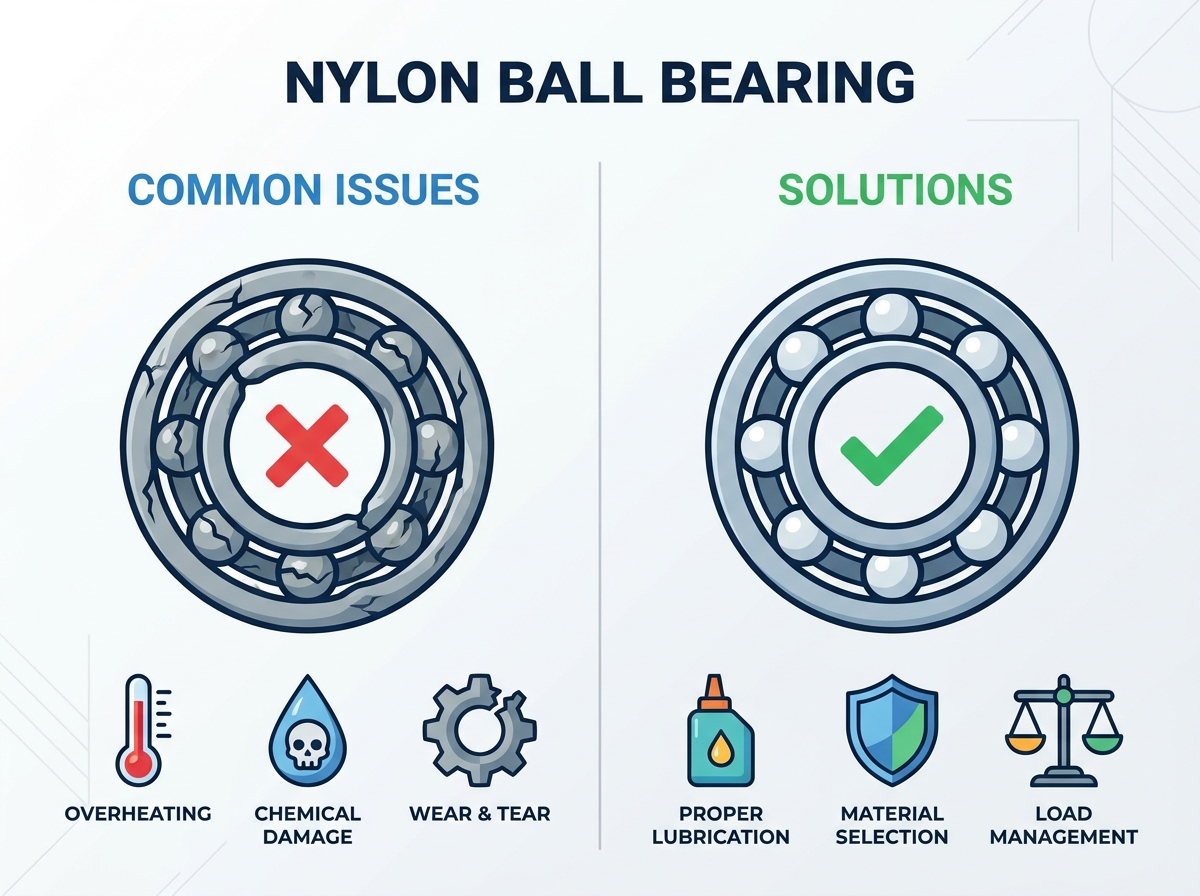
Issue 1: Moisture Absorption and Dimensional Swelling
Symptoms and Identification
Moisture absorption presents clear physical symptoms. You will often notice the bearing binding or seizing on the shaft. There is a distinct loss of axial clearance. As the internal clearance vanishes, rotational torque increases heavily. This creates noticeable operational drag that strains motors and drive systems. Operators might report that the machine feels sluggish or draws more amperage than usual.
Another symptom is inconsistent performance based on weather or plant conditions. If the equipment runs fine during dry winter months but binds up during humid summer days, moisture is the likely culprit. You might also see the outer ring bulging if it is press-fit into a rigid housing. The material has nowhere to go but inward, clamping down on the rolling elements.
To identify this issue, measure the internal diameter of a failed unit and compare it to a brand-new one. A measurable decrease in the inner diameter confirms swelling. You can also weigh the failed component. A water-logged polymer will weigh slightly more than a dry, new component, though this requires a highly precise scale.
Root Causes
The root cause lies in the inherent hygroscopic nature of the material. Standard polymers absorb water directly from high-humidity environments. Heavy washdown procedures in food processing also force moisture into the polymer matrix. As the material absorbs water, it physically expands, destroying the engineered tolerances.
Submerged applications are particularly brutal. Continuous exposure to liquids guarantees maximum absorption. Even intermittent splashing allows enough moisture ingress to cause problems over time. The rate of absorption depends on the specific grade of the material and the temperature of the water.
Improper storage before installation also leads to swelling. If spare parts sit in a damp warehouse for months, they will absorb moisture before they ever see a machine. Installing a pre-swelled component guarantees immediate binding and rapid failure upon startup.
Engineering Solutions and Mitigation
You can mitigate swelling through careful preparation and design. Pre-condition the bearings prior to installation to stabilize their dimensions. Calculate moisture-adjusted tolerances during the initial design phase to allow for expected expansion. If swelling remains a persistent issue, consider alternative materials. Specifying Acetal (POM) or PET-based bearings works exceptionally well for submerged or heavy washdown applications.
Here are specific steps to handle moisture issues:
- Measure the ambient humidity of the operating environment over a two-week period.
- Calculate the expected dimensional change using the manufacturer's moisture absorption charts.
- Increase the initial internal clearance of the specified bearing to accommodate the calculated expansion.
- Store all spare polymer components in sealed, desiccant-lined bags until the exact moment of installation.
- Switch to a non-hygroscopic polymer blend if the application involves direct liquid submersion.
Issue 2: Thermal Expansion and Heat Degradation
Symptoms and Identification
Heat damage leaves obvious visual clues. Look for discoloration, melting, or severe cage distortion. In extreme cases, you will experience sudden catastrophic failure, locking, or shaft binding. You might also find lubricant carbonization, which looks like a crusty black residue. Sometimes, grease simply gums out under localized thermal spikes.
You will often smell burning plastic before the machine completely seizes. The outer ring may warp, losing its perfectly cylindrical shape. If you cut the bearing open, the internal raceways will look smeared rather than smoothly worn. This smearing indicates the material reached its glass transition temperature and began to flow under load.
Infrared thermometers are excellent diagnostic tools here. Shoot the housing during operation. If the temperature steadily climbs without plateauing, the internal friction is generating more heat than the system can dissipate. This thermal runaway always ends in a melted component.
Root Causes
Thermal degradation happens when ambient temperatures exceed the continuous operating limit of the standard material. This limit typically sits around 180°F to 210°F (82°C to 99°C). Excessive internal friction also generates destructive heat. Running at high RPMs without adequate heat dissipation rapidly melts polymer components.
External heat sources are often overlooked. Proximity to ovens, steam pipes, or uninsulated exhaust manifolds bakes the polymer. Even if the internal friction is low, the ambient heat will push the material past its thermal threshold. The combination of internal friction and external heat is particularly deadly.
Lack of airflow exacerbates the problem. A bearing enclosed in a tight, unventilated housing cannot shed heat. The temperature inside the housing climbs steadily, eventually softening the polymer cage and causing the rolling elements to bunch together.
Engineering Solutions and Mitigation
Always verify RPM limits and PV (Pressure-Velocity) values for your specific bearing size. Increase initial internal clearances to accommodate expected thermal expansion. If your application routinely exceeds 210°F, standard polymers will not survive. Upgrade to high-temperature polymers like PEEK or PTFE-blends for these extreme environments.
| Material Type | Max Continuous Temp | Best Application |
| Standard Polymer | 180°F - 210°F | Light load, room temperature |
| Acetal (POM) | 180°F - 200°F | High moisture, moderate temp |
| PTFE Blends | 300°F - 350°F | High heat, low friction needs |
| PEEK | 450°F - 480°F | Extreme heat, high load |
Issue 3: Lubrication Incompatibility, Starvation, and Over-Lubrication
Symptoms and Identification
Lubrication failures are often loud. You will hear grinding noises or high-pitched squealing. Visual inspection may reveal pitting on the raceways or polymer galling. Chemical breakdown causes cracking or embrittlement of the material. Conversely, you might see excessive grease leakage, migration, or high rotational drag caused by fluid churning.
When chemical incompatibility occurs, the plastic often changes color or becomes brittle enough to snap under light pressure. If you wipe away the grease and see a chalky surface on the raceway, the lubricant is actively eating the polymer. Over-lubrication presents as a massive mess around the housing, with grease pushing past the seals and collecting dirt.
Starvation leaves the raceways looking polished but deeply grooved. Without a hydrodynamic film, the balls scrape directly against the plastic. This generates fine plastic dust that mixes with whatever tiny amount of grease is left, creating a sticky, abrasive paste.
Root Causes
Chemical incompatibility occurs when petroleum-based greases attack specific polymer grades. Lubricant volume issues also destroy bearings. Insufficient lubricant causes dry friction and rapid wear. Excessive grease leads to fluid churning, massive heat generation, and seal blowout. Particulate ingress is another major factor. Dust, grit, or process fibers embed into the softer polymer raceways, acting as a destructive abrasive compound.
Maintenance teams often cause over-lubrication by aggressively using grease guns during routine PMs. Pumping a housing completely full of grease leaves no room for thermal expansion. The churning grease generates immense heat, which softens the plastic and leads to rapid failure.
Starvation usually happens when automated lubrication systems fail or lines get pinched. In manual setups, it happens simply because the lubrication point is hard to reach and gets skipped. The resulting dry running conditions destroy the raceway geometry in a matter of hours.
Engineering Solutions and Mitigation
Select polymer-safe synthetic lubricants, such as silicone or specific fluorinated greases. Enforce strict grease-fill limits, keeping volume to 30% to 50% of internal free space for high-speed runs. Implement shielded or sealed designs to block contaminants. If loads and speeds permit, rely purely on the self-lubricating properties of the material.
Implement these lubrication best practices:
- Tag all grease zerks with the specific synthetic grease required to prevent cross-contamination.
- Train maintenance staff to use measured grease shots rather than pumping until grease purges from the seals.
- Install automatic lubricators calibrated to deliver precise micro-doses of polymer-safe oil.
- Use double-sealed bearing variants in environments with heavy airborne dust or paper fibers.
- Conduct compatibility tests by soaking a spare polymer ring in the proposed lubricant for 48 hours and checking for softening.
Issue 4: Mechanical Overload, Fatigue, and Aging
Symptoms and Identification
Mechanical overload manifests as structural damage. You will see cracking on the inner or outer ring. Look for flat spots on the balls or raceway deformation, commonly known as brinelling. Visible surface pitting is also common. Over time, the assembly develops excessive axle play or radial looseness.
Shock loads often fracture the cage first. If you hear a rattling sound, the cage has likely broken, allowing the balls to bunch up on one side. This leads to immediate binding. Brinelling looks like evenly spaced dents in the raceway, corresponding exactly to the ball spacing. This happens when a heavy static load presses the balls into the soft plastic.
Aging out is more subtle. The material simply loses its mechanical properties over millions of cycles. It becomes brittle and micro-cracks form along the stress zones. You will notice a gradual increase in vibration and noise over several months before the final failure occurs.
Root Causes
Subjecting the bearing to shock loads destroys the polymer structure. Continuous loads exceeding static or dynamic ratings cause rapid deformation. Vibration-induced fatigue breaks down the material over prolonged operational cycles. Finally, natural material aging occurs under sustained cyclical stress, causing the component to simply age out.
Improper belt tensioning is a massive source of mechanical overload. Over-tightened belts pull the shaft hard against one side of the bearing, exceeding the radial load capacity. This causes uneven wear and rapid heat buildup. Misaligned pulleys also introduce severe axial loads that standard radial bearings cannot handle.
Start-stop applications are particularly hard on polymers. The constant acceleration and deceleration create torque spikes that stress the cage and raceways. If the machine jams, the sudden stop transfers massive kinetic energy directly into the plastic components, often shattering them instantly.
Engineering Solutions and Mitigation
Recalculate application load requirements against the manufacturer's load charts. Distribute heavy loads by increasing the bearing size or utilizing multiple bearings on the shaft. If standard polymers cannot handle the stress, transition to glass-reinforced materials. Hybrid bearings featuring polymer cages with stainless steel or ceramic balls also offer significantly higher load capacities.
| Overload Type | Visual Evidence | Engineering Fix |
| Static Overload | Deep dents in raceway (Brinelling) | Increase bearing size or use glass-filled polymer |
| Dynamic Overload | Severe raceway smearing, flat balls | Upgrade to hybrid bearing with steel balls |
| Shock Loading | Fractured cage, cracked outer ring | Install shock-absorbing couplings on the shaft |
| Axial Overload | Wear heavily skewed to one side of raceway | Re-align pulleys and check belt tension |
Issue 5: Misalignment and Installation Errors
Symptoms and Identification
Installation errors leave distinct wear patterns. You will notice uneven wear paths skewed across the polymer raceway. Premature cage failure, high friction spikes, or excessive vibration usually occur immediately after installation. The axle or shaft may also run loose or visibly off-center.
If a bearing fails within the first 48 hours of operation, installation error is almost always the cause. Look for hammer marks or scoring on the faces of the rings. This indicates someone used improper tools to force the component onto the shaft. You might also see the outer ring shaved or peeled if it was forced into an undersized housing.
Misalignment causes the shaft to wobble. You can measure this runout with a dial indicator. If the runout is high, the bearing is fighting the shaft on every rotation. This generates massive internal stress and heat, destroying the plastic raceway in short order.
Root Causes
Improper press-fit techniques cause severe housing distortion or ring damage. Pressing on the wrong ring transfers destructive force through the rolling elements. Shaft deflection or out-of-square mounting surfaces force the bearing to operate at severe angles, rapidly destroying the polymer raceway.
Using a hammer and punch is the most common installation sin. This localized impact shatters the plastic and dents the raceways. Even using an arbor press incorrectly causes damage if the pressing tool does not sit perfectly flat against the correct ring.
Bent shafts or warped frames make perfect alignment impossible. Even if you install the bearing perfectly, the bent shaft will force it out of alignment as soon as the machine starts. Thermal expansion of the machine frame can also push mounting points out of square during operation.
Engineering Solutions and Mitigation
Adhere strictly to recommended shaft and housing interference tolerances for plastic components. Use proper arbor presses and installation tools. Always apply even force to the correct, press-fitted ring. Never press against the unmounted ring. If structural misalignment cannot be engineered out of the machine, integrate self-aligning bearing designs.
- Measure the shaft and housing with a micrometer before installation to verify tolerances.
- Use a dedicated bearing heater or freezing technique to expand/contract metal mating parts, allowing the plastic bearing to slide in without force.
- Fabricate custom pressing sleeves that contact only the ring being press-fit.
- Check shaft alignment with a laser alignment tool before bolting down the housings.
- Specify self-aligning housings that can pivot slightly to accommodate minor frame warping.
Decision Framework: When to Replace vs. When to Upgrade
Deciding whether to replace a part with an identical component or upgrade to a new material requires careful evaluation. Look at the features-to-outcomes ratio. Ask yourself if the current specification truly aligns with the application's actual environmental and mechanical demands. If a component fails repeatedly, the standard material is likely insufficient.
Consider scalability and compliance. Upgrading the material often reduces maintenance intervals and helps meet strict industry standards, such as FDA compliance for food processing. You must weigh the low upfront cost of standard parts against the heavy cost of machine downtime and labor required for frequent replacements.
Address the implementation risks of changing materials. A harder polymer might wear the shaft instead of the bearing. You must mitigate this risk by verifying proper shaft hardness specifications before upgrading. Always match the polymer hardness to the mating hardware to prevent unexpected shaft damage. Upgrading to a glass-filled polymer requires a hardened steel shaft to prevent the glass fibers from grooving the metal.
Review the failure history logs. If the failures are random and spaced years apart, direct replacement is fine. If the failures happen every three months on the exact same machine, you have a systemic issue that requires an engineering upgrade. Do not keep throwing standard parts at a high-stress problem.
Consult with your material supplier. They can provide specific PV limits, chemical compatibility charts, and thermal expansion coefficients. Use this data to select the exact polymer blend that matches your operating environment. A custom-engineered solution often pays for itself within the first year of operation by eliminating unplanned downtime.
Conclusion
- Document all failure symptoms, including moisture swelling, heat deformation, and abnormal visual pitting, to determine the exact root cause.
- Verify your operating environment temperatures and moisture levels against the maximum thresholds of standard polymer materials.
- Audit your lubrication practices to ensure you are using polymer-safe synthetic greases at the correct fill volumes.
- Consult with an application engineer to request a material compatibility chart tailored to your specific operating conditions.
- Submit your exact operational parameters, including loads and RPMs, for a custom hybrid or high-temperature bearing quote.
FAQ
Q: How long should a nylon ball bearing last?
A: Lifecycle expectations depend heavily on operating conditions. If kept within its Pressure-Velocity limits, isolated from extreme heat, and protected from abrasive contamination, it can last for years. However, high moisture, excessive loads, and natural material aging will significantly shorten its operational life.
Q: Can you lubricate a nylon ball bearing?
A: Yes, but it requires caution. The material has natural self-lubricating properties. If you add external lubrication, you must use polymer-safe synthetic greases like silicone. Petroleum-based lubricants can chemically degrade the plastic. Additionally, over-lubrication causes fluid churning and excessive heat buildup.
Q: Why is my nylon bearing making a grinding noise?
A: Grinding noises usually indicate particulate contamination. Dust, grit, or process fibers can bypass seals and embed directly into the soft polymer raceways. This creates an abrasive compound that grinds against the rolling elements. Extreme dry friction from lubrication starvation can also cause this noise.
Q: What causes a nylon bearing to gum out or seize?
A: Seizing or gumming out happens when high operational heat causes incompatible lubricants to carbonize. The grease breaks down into a sticky, crusty residue. Particulate accumulation mixed with degraded grease also creates a thick paste that locks the rolling elements in place.
Q: Does water affect nylon bearings?
A: Yes. Standard polymers are highly hygroscopic, meaning they absorb water from high-humidity environments or direct washdowns. This moisture absorption causes the material to swell physically. The swelling eliminates internal clearances, leading to high friction, shaft binding, and eventual failure.
Q: What is the maximum operating temperature for a nylon ball bearing?
A: Standard materials typically have a maximum continuous operating limit between 180°F and 210°F. Exceeding this range causes softening, cage distortion, and rapid failure. For temperatures above 210°F, you should specify high-temperature alternatives like PEEK or PTFE blends.
Q: How do you fix a misaligned plastic bearing?
A: You must adhere strictly to recommended shaft and housing interference tolerances. Use proper arbor presses and apply even force to the correct press-fitted ring. If structural misalignment cannot be engineered out of the machine frame, integrate self-aligning housing options to compensate for the deflection.

 English


