Gearbox failure frequently originates at the bearing level, making the decision to repair or replace a pivot point for operational continuity, fleet maintenance, and industrial budgets. Asset owners and engineers must balance the immediate hard costs of bearing replacement against the severe financial impact of unplanned downtime, secondary component damage, and recurring driveline failures. When a bearing degrades, it introduces misalignment and vibration that cascades through the entire geartrain. Addressing this early prevents a standard maintenance task from escalating into a catastrophic mechanical failure.
A realistic, evidence-based breakdown of what to expect when sourcing and installing a replacement bearing for Gearbox applications provides clarity. Understanding industrial versus automotive labor variables, structural decision frameworks, and implementation risks helps maintenance teams allocate resources effectively. Maintenance personnel need actionable data to evaluate repair scopes, labor requirements, and downtime implications accurately without relying on guesswork.
- Direct replacement costs are highly scalable, ranging from under $1,000 for standard small gear reducers to over $150,000 for specialized, high-capacity industrial gearboxes or wind turbine drives.
- Passenger vehicle and manual transmission gearbox bearing replacements face distinct constraints, often requiring teardowns at the 70,000 to 100,000-mile mark that cost between $1,500 and $4,000 due to intensive labor.
- Early detection of bearing wear drastically reduces repair scopes; delayed action often necessitates a full gearbox rebuild due to secondary shaft, transfer clutch, or gear tooth damage.
- The true cost of replacement must factor in lost production hours, specialized labor, rigging, and lubrication system flushings, which frequently exceed the price of the physical bearing.
- Selecting the correct replacement strategy requires identifying the root cause of the initial failure (e.g., misalignment, lubrication breakdown) to prevent immediate recurrence.
Diagnosing the Need for a Replacement Bearing for Gearbox Units
Early Warning Signs vs. Critical Failure in Industrial Systems
Detecting bearing wear early prevents catastrophic system failure and limits the scope of required repairs. Objective indicators begin with distinct changes in vibration signatures. Technicians utilize acceleration enveloping and PeakVue methodologies to isolate high-frequency stress waves generated by microscopic subsurface fatigue. These tools detect faults long before they become audible or affect overall machine vibration levels. Thermal imaging provides another diagnostic layer, revealing localized temperature spikes at the bearing housing that point to increased friction, inadequate lubrication, or excessive preload.
Oil analysis serves as a mandatory diagnostic tool in industrial environments. Techniques like ferrography and ISO particle counting identify microscopic metal particulates. The presence of spherical particles often indicates bearing fatigue, while cutting wear suggests severe misalignment. Early-stage spalling or pitting allows for planned maintenance interventions during scheduled outages. In contrast, catastrophic cage failure leads to shaft dropping, severe misalignment, and the destruction of surrounding internal components. Recognizing the difference between these stages dictates the urgency and scope of the required intervention.
| Failure Stage | Diagnostic Indicator | Physical Condition | Required Action |
| Stage 1 | Ultrasonic frequencies detected | Subsurface micro-cracking | Monitor closely, check lubrication |
| Stage 2 | Natural frequencies ringing | Surface pitting begins | Schedule replacement during next outage |
| Stage 3 | Harmonics of defect frequencies | Visible spalling, audible noise | Immediate replacement required |
| Stage 4 | Broadband high-frequency noise, high heat | Cage failure, shaft dropping | Emergency shutdown, full rebuild |
Wear Signs in Automotive and Manual Transmission Gearboxes
Manual gearbox bearing wear presents specific audible and physical symptoms that differ from industrial applications. Drivers often report high-pitched transmission whining or growling tied to specific gears. An input shaft bearing typically makes noise when the clutch is engaged and the transmission is in neutral. Conversely, output shaft bearing noise changes pitch and volume in direct relation to vehicle speed, regardless of the selected gear. Difficulty shifting smoothly and noticeable clutch chatter also indicate internal bearing deterioration affecting shaft alignment.
Related components become highly vulnerable as mileage increases. Wear within the transfer clutch, viscous coupling, or manual transmission gear synchronizers frequently accelerates at higher mileages. When a bearing loses its tolerance, the resulting shaft play prevents synchronizer rings from matching gear speeds effectively, leading to grinding during shifts. Addressing bearing noise promptly protects these expensive secondary systems from collateral damage and prevents the need for a complete transmission replacement.
Assessing Secondary Damage and Scope Creep
Replacing just the bearing rarely serves as a standalone fix if the failure has advanced beyond initial wear stages. Circulating metal debris acts as an abrasive lapping compound, compromising the entire internal environment. Technicians must conduct a thorough inspection of all adjacent components to determine the true scope of the repair.
- Drain the lubricant through a filter screen to capture and analyze large debris.
- Measure shaft runout using a dial indicator to check for bending or distortion caused by the bearing failure.
- Inspect gear teeth for frosting, macropitting, or scoring, which indicates debris contamination in the mesh.
- Measure the housing bores with a cylinder bore gauge to ensure the bearing seat has not become out-of-round or oversized.
- Examine all input and output seals for heat damage or lip wear caused by excessive shaft deflection.
Failing to address this secondary damage guarantees rapid failure of the newly installed bearing. Installing a precision bearing into an out-of-round housing or onto a scored shaft turns a localized repair into a recurring maintenance nightmare.
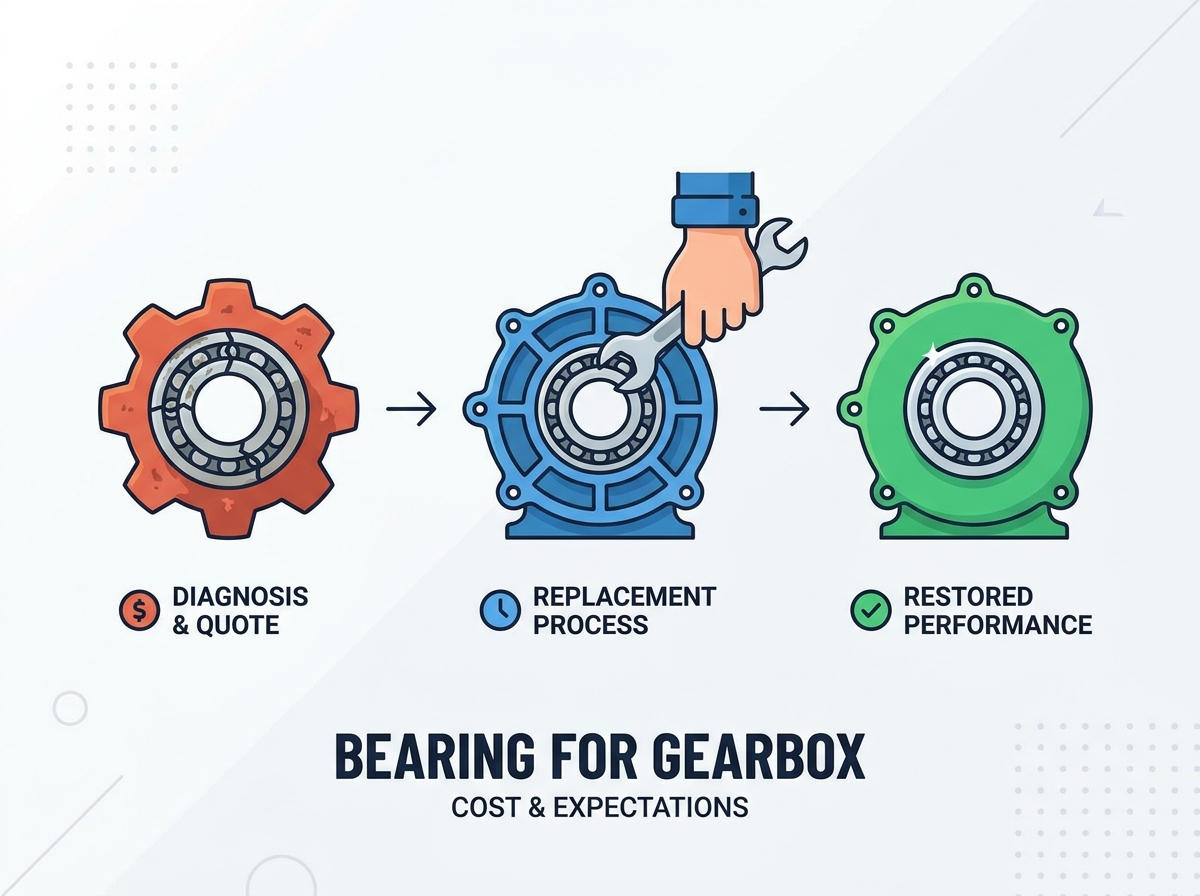
Cost Breakdown: What Does Gearbox Bearing Replacement Actually Cost?
Automotive and Passenger Vehicle Gearboxes
Passenger car bearing replacements involve significant labor hours. Professional transmission teardowns require removing the transmission from the vehicle, splitting the case, and pressing off gears and bearings. The complexity of accessing the gearbox drives the labor overhead far higher than the price of the physical parts. Front-wheel-drive transaxles often require dropping the subframe, adding hours to the repair manual times compared to rear-wheel-drive longitudinal layouts.
Vehicle owners face a choice between sourcing remanufactured manual gearboxes versus brand-new OEM assemblies. Replacing related wear items, like clutches, rear main seals, or viscous couplings, simultaneously improves labor efficiency. Grouping these repairs drops the overall labor overhead significantly compared to performing each repair separately. Technicians should always recommend replacing the clutch assembly while the transmission is removed to maximize the value of the labor hours already invested.
Small to Medium Industrial Gear Reducers
Standard commercial and light industrial gear reducers power conveyors, mixers, and standard manufacturing equipment. The scale of the repair dictates the final invoice, but bench labor often dominates the cost structure in smaller units. Teardown, precise shimming, and reassembly require skilled technician hours. Setting the correct endplay or preload on tapered roller bearings requires patience, precision measuring tools, and multiple assembly/disassembly steps to get the shim pack exactly right.
The physical bearing cost represents a smaller fraction of the total expense compared to the specialized labor required to set tolerances correctly. Attempting to save money by using unskilled labor for these rebuilds usually results in incorrect preload settings, leading to immediate overheating and premature failure upon startup.
Large-Scale Industrial Gearboxes
Heavy-duty applications, such as mining equipment, wind turbines, and heavy manufacturing, involve massive financial commitments and logistical challenges. The scale and complexity of the machinery drive premium labor and equipment costs. Replacing a main shaft bearing in a wind turbine, for example, requires specialized up-tower lifting equipment or massive crawler cranes if the nacelle must be lowered to the ground.
Compounding cost factors escalate the final bill rapidly. Custom machining to repair spun bearing housings, specialized rigging, and crane rentals add significant overhead. Bespoke bearing manufacturing lead times further complicate the process. Large spherical roller bearings or specialized planetary gear bearings often have lead times stretching into months, requiring extensive logistical planning and condition monitoring to ensure the machine survives until the parts arrive.
Calculating the Hidden Cost of Downtime
The physical repair bill represents only a fraction of the total financial impact. Calculating the Total Cost of Repair requires factoring in lost revenue and production bottlenecks. The formula combines Direct Repair Costs with the Hourly Production Value multiplied by the Hours of Downtime. In continuous process industries like paper milling or petrochemical refining, an hour of downtime dwarfs the cost of the bearing and the labor combined.
Facility managers must weigh the financial trade-offs of paying premiums for expedited aftermarket parts against waiting for OEM lead times. Extended downtime often costs exponentially more than overnight shipping fees, expedited machining services, or flying in specialized technicians. Maintaining critical spare bearings in inventory remains the most effective strategy for mitigating these massive downtime costs.
Repair, Rebuild, or Replace: The Decision Framework
Scenario 1: Targeted Bearing Replacement
Targeted replacement suits early detection scenarios. Success relies on a teardown revealing zero damage to gears, shafts, or the housing bore. This approach isolates the repair to the failed component and assumes the lubrication system remains uncontaminated. Technicians simply press off the old bearing, heat the new bearing using an induction heater, and drop it onto the shaft.
This scenario offers the lowest direct cost and fastest turnaround time. However, it requires absolute confidence in root cause resolution. If underlying issues like soft foot, pipe strain, or thermal growth remain unaddressed, the new bearing will fail rapidly. Targeted replacement works best when the failure is purely age-related fatigue rather than an environmental or alignment issue.
Scenario 2: Comprehensive Gearbox Rebuild
A comprehensive rebuild becomes necessary when bearing failure introduces metal shavings into the lubrication system. This requires full decontamination, re-machining of tolerances, and replacement of all wear parts, including seals, shims, and sometimes gears. The housing must be thoroughly flushed, and oil galleries must be brushed and blown out with compressed air to ensure no debris remains.
This approach provides a "like-new" operational baseline. It extends the asset's lifespan significantly without requiring the massive capital expenditure associated with purchasing a completely new unit. Rebuilding allows facilities to retain their existing footprint and mounting arrangements, avoiding the engineering costs associated with retrofitting a different gearbox model into the production line.
Scenario 3: Full Gearbox Replacement
Full replacement triggers when repair costs exceed the standard 60-70% threshold of the price of a new unit. Severe housing damage, such as a cracked casing or a severely spun bearing bore that cannot be sleeved, mandates replacement. Catastrophic internal failure where multiple gear sets are destroyed also pushes the decision toward replacement. Attempting to repair a heavily compromised unit invites future failures and unreliable operation.
Replacing the entire unit provides an opportunity to upgrade to modern, more efficient designs. Upgrading to a gearbox with better sealing technology, synthetic lubrication compatibility, or higher service factors supports operational scalability. It also ensures compliance with updated industry standards and safety regulations, providing a long-term solution rather than a stopgap fix.
Selecting the Right Bearing for Gearbox Applications
OEM vs. Aftermarket Bearings: Trade-offs
Sourcing Original Equipment Manufacturer bearings guarantees exact specifications, proper internal clearances, and correct cage materials. OEM parts provide peace of mind regarding material quality and dimensional accuracy. However, they often involve higher costs and potential lead time issues, especially for older or obsolete gearbox models.
Aftermarket alternatives offer better availability and cost savings. However, variable quality control requires careful vetting of the supplier. Selecting premium aftermarket brands mitigates the risk of installing substandard components. Maintenance teams must ensure the aftermarket bearing matches the exact ABEC rating, radial internal clearance (e.g., C3 or C4), and load capacity of the original part.
Load, Application, and Environmental Considerations
Matching bearing types to specific operational stresses ensures longevity. Engineering specifications must dictate the selection process based on the forces at play within the gearbox.
- Tapered Roller Bearings: Ideal for handling heavy combined radial and axial loads, commonly used on input and output shafts.
- Spherical Roller Bearings: Designed to accommodate heavy radial loads and moderate axial loads while compensating for shaft misalignment.
- Cylindrical Roller Bearings: Best suited for high-speed applications with heavy radial loads but minimal axial forces.
Operating environments heavily influence bearing seal selection and lubrication requirements. Extreme temperatures require specialized greases or synthetic oils with high viscosity indexes. High moisture and heavy particulate areas demand specialized sealing arrangements, such as labyrinth seals or taconite seals, to prevent premature contamination and failure.
Implementation Risks and Mitigation Strategies
Installation and Assembly Errors
Improper installation ruins new bearings instantly. Common failure points include improper shrink fits, incorrect clearance settings, and contamination of the housing during assembly. Using a hammer and punch to drive a bearing onto a shaft damages the rolling elements and creates brinelling on the raceways. Overheating a bearing with a torch alters the metallurgy and destroys the temper of the steel.
Mitigation requires strict adherence to manufacturer procedures. Technicians must use induction heaters with temperature probes, ensuring the bearing never exceeds 120°C (250°F) during expansion. Assembly should occur in clean, climate-controlled environments whenever possible. Precision measuring tools, such as feeler gauges and dial indicators, ensure correct seating, alignment, and endplay.
The Danger of Root Cause Ignorance
Installing a new bearing without addressing the original failure mechanism guarantees a repeat failure. Shaft misalignment, inadequate lubrication viscosity, and operational overloading destroy replacement components just as quickly as the originals. If a bearing failed due to water ingress, replacing the bearing without upgrading the breather or seals solves nothing.
Failure analysis must precede reassembly. Examining the wear patterns on the failed bearing raceways reveals the root cause. Flaking on one side of the raceway indicates axial overloading, while diagonal wear paths indicate misalignment. Identifying and correcting the root cause ensures the new bearing achieves its designed lifespan. Treating the symptom rather than the disease wastes maintenance budgets and consumes valuable labor hours.
Vetting Repair Partners and Technicians
Selecting a qualified third-party repair facility minimizes risk for complex rebuilds. Look for ISO 9001 certifications and EASA accreditation, which demonstrate a commitment to quality control and standardized procedures. In-house machining capabilities streamline the repair process, allowing the shop to sleeve worn housings or manufacture custom shims without relying on outside vendors.
Mandatory post-repair load testing verifies the integrity of the rebuild. Facilities that cannot simulate operational loads, monitor temperatures, and record vibration signatures before returning the unit introduce unacceptable risk to the production environment. A proper repair shop provides a comprehensive teardown report, a detailed scope of work, and a final test run certificate.
Conclusion
- Pull an oil sample from the gearbox immediately and send it to a certified laboratory for wear particle analysis and viscosity testing.
- Mount vibration sensors on the bearing housings to establish a baseline signature and detect high-frequency stress waves.
- Schedule a borescope inspection during the next planned outage to visually check for gear tooth frosting or bearing cage damage.
- Audit your current lubrication program to ensure the correct viscosity, additive package, and fill levels are being maintained.
- Contact a certified repair facility to establish a contingency plan and verify lead times for critical replacement parts.
FAQ
Q: How long does it take to replace a bearing in an industrial gearbox?
A: Standard in-stock replacements typically take 2 to 5 days, depending on the unit's size and accessibility. Custom-machined rebuilds or specialized bearings can extend the timeline to several weeks or months due to manufacturing and shipping lead times.
Q: Can I replace a bearing for gearbox systems without removing the gearbox?
A: In-situ repairs are rarely recommended. Full removal is usually required to properly clean the housing, inspect adjacent components, and accurately set critical clearances and tolerances on a workbench.
Q: What causes a gearbox bearing to fail prematurely?
A: The top factors causing premature failure include lubrication breakdown or contamination, shaft misalignment, operational overloading, and improper installation techniques that damage the rolling elements.
Q: Is it cheaper to rebuild a gearbox or buy a new one?
A: Reliability engineers generally use a 60-70% cost threshold rule of thumb. If the cost to rebuild exceeds 60-70% of the price of a new unit, purchasing a new gearbox is typically the more economical long-term choice.
Q: How often should gearbox bearings be replaced?
A: Replacement should be condition-based, driven by predictive maintenance tools like vibration analysis and oil sampling. Strictly time-based replacement often results in discarding healthy components or missing early-stage failures.
Q: At what mileage do automotive manual gearbox bearings typically require replacement?
A: Automotive manual gearbox bearings typically show significant wear between 70,000 and 100,000 miles. Warning signs include high-pitched transmission noise, gear slippage, and difficulty shifting smoothly.

 English


