Bearings serve as the mechanical foundation of industrial power transmission. They support rotating shafts, maintain precise gear mesh alignment, and minimize friction under extreme mechanical stress. Selecting the correct bearing for Gearbox applications dictates the operational lifespan of the entire drive system. Improper bearing selection remains a primary root cause of premature gearbox failure. When a bearing fails, it often leads to catastrophic operational downtime, severe secondary damage to gear teeth, and extensive replacement efforts. To prevent these failures, engineers must apply a rigorous evaluation framework. You need to carefully weigh load requirements, speed ratings, environmental conditions, and lifecycle maintenance needs to specify the optimal bearing for any industrial gearbox.
- Load Profiling is Non-Negotiable: Matching the specific bearing type (e.g., tapered, cylindrical, spherical) to the exact ratio of radial and axial loads dictates gearbox longevity and reliability.
- Rolling vs. Plain Dynamics: Rolling bearings provide distinct operational advantages over plain bearings in modern gearboxes, specifically regarding lower starting torque, reduced friction at high speeds, and superior efficiency during start-stop cycles.
- Specification Requires System-Level Analysis: Proper selection demands evaluating the bearing within the context of the entire gearbox system, including thermal expansion, housing tolerances, contamination risks, and acoustic/noise requirements.
The Role of a Bearing for Gearbox Performance and Reliability
A successful bearing application in a gearbox hinges on meeting strict performance criteria. Engineers target specific L10 fatigue life ratings, minimal vibration thresholds, and stable thermal operating ranges. When a bearing operates within these parameters, the gearbox runs smoothly. If the bearing falls short, the entire system suffers from excessive heat and vibration. You must evaluate the dynamic load ratings against the actual operating conditions to ensure the bearing will survive the intended design life.
Friction reduction directly impacts power transfer efficiency. Bearings minimize mechanical losses between the input and output shafts. This reduction in drag translates directly to a higher overall efficiency rating for the gearbox. Less energy lost to friction means more usable power delivered to the driven equipment. Industrial facilities rely on this efficiency to maintain production quotas and reduce energy consumption across large-scale operations.
Managing axial and radial loads is a fundamental requirement. Different gear types generate distinct force vectors. Helical and bevel gears create significant axial thrust alongside radial loads. The bearing must absorb these combined forces and transfer them safely to the rigid gearbox housing without allowing shaft deflection. Proper load management prevents premature wear on the gear teeth and ensures the transmission operates quietly.
Rolling bearings dominate industrial gearboxes over plain bearings for several reasons. They offer exceptionally low starting torque and maintain low operational friction across a broad RPM range. This makes them highly reliable for continuous industrial operations. Plain bearings often require complex, pressurized lubrication systems to survive similar speeds. Rolling elements simplify the lubrication requirements and reduce the overall complexity of the gearbox design.
Acoustic performance is increasingly important in modern facilities. Bearing design, internal geometry, and surface finish directly influence vibration and decibel levels. Low-noise operations are mandatory in many municipal and indoor industrial environments. Precision-ground raceways and optimized rolling elements help achieve these strict acoustic targets. Engineers must specify bearings with tight manufacturing tolerances to minimize noise generation during high-speed operation.
To further understand the impact of bearings on gearbox reliability, consider the following operational factors:
- Shaft alignment precision during initial assembly.
- Operating temperature fluctuations and thermal expansion.
- Vibration frequencies generated by the gear mesh.
- Lubricant viscosity changes under varying loads.
- Contamination ingress from harsh industrial environments.
- Shock loads from sudden starts or stops in the driven machinery.
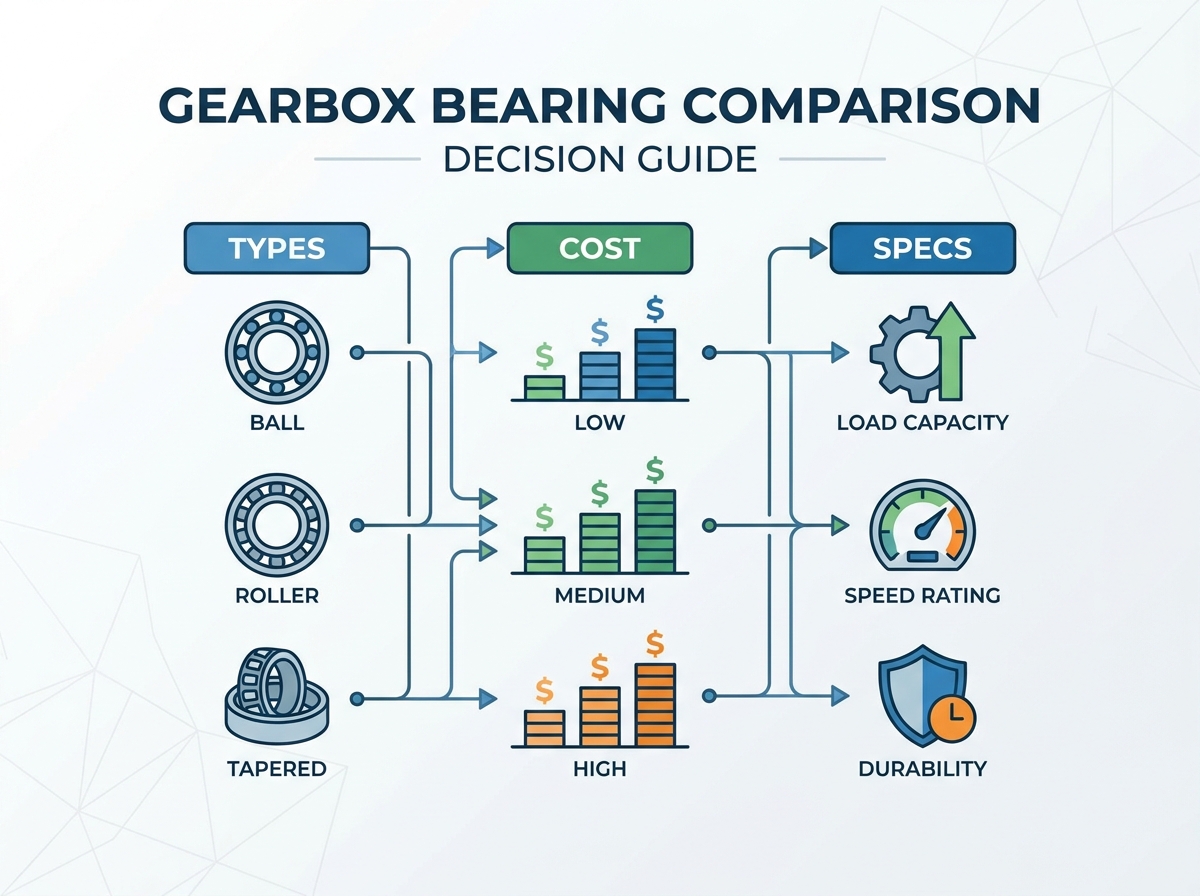
Core Types of Gearbox Bearings
Understanding the specific capabilities of different bearing designs is essential for proper specification. Each type offers unique advantages and distinct trade-offs. You must match the bearing type to the specific load profile of the gearbox shaft.
Tapered roller bearings handle combined heavy radial and axial loads. You will frequently find them on output shafts, bevel gear drives, and heavy-duty industrial reducers. They offer high axial stiffness and massive load capacity. However, they require precise end-play adjustment and preloading during installation. Mechanics must use dial indicators to set the exact clearance required for optimal performance.
Cylindrical roller bearings provide maximum radial load capacity. Standard versions cannot accommodate axial loads. They are commonly used on high-speed input shafts, intermediate shafts, and spur gear applications. They provide high rigidity but have zero tolerance for shaft misalignment. The housing and shaft must be machined to exact tolerances to prevent edge loading on the rollers.
Spherical roller bearings handle heavy radial loads, moderate axial loads, and severe shock loads. They excel in heavy industrial gearboxes used in mining, cement, and wind turbines where shaft deflection or housing misalignment is expected. The trade-off is higher internal friction, which lowers their maximum speed capabilities. These bearings self-align to compensate for minor machining errors or heavy load deflections.
Deep groove ball bearings are highly versatile with high-speed capability. They handle moderate radial and low axial loads. You will see them in light-duty gearboxes, auxiliary shafts, and fractional horsepower applications. They are unsuitable for heavy industrial shock loads. Their simple design makes them easy to install and maintain in standard applications.
Needle roller bearings offer high radial load capacity with a minimal cross-sectional profile. They are the standard for planetary gearboxes, automotive manual transmissions, and space-constrained designs. They are highly sensitive to shaft bending and require hardened, ground shaft raceways. The shaft itself often acts as the inner ring to save space.
| Bearing Type | Primary Load Capacity | Typical Gearbox Application | Key Limitation |
| Tapered Roller | Heavy Radial & Axial | Bevel drives, output shafts | Requires precise preloading |
| Cylindrical Roller | Maximum Radial | High-speed input shafts | Zero misalignment tolerance |
| Spherical Roller | Heavy Radial, Shock Loads | Mining, wind turbines | Lower maximum speed limit |
| Deep Groove Ball | Moderate Radial, Low Axial | Light-duty, auxiliary shafts | Unsuitable for heavy shock |
| Needle Roller | High Radial, Compact Space | Planetary gear systems | Requires hardened raceways |
Bearing Selection Framework by Gearbox Type
Different gearbox architectures demand specific bearing arrangements to handle unique load distributions. Spur and helical gearboxes require a strategic mix. You should focus on high radial capacity for the high-speed input shafts, often utilizing cylindrical or ball bearings. For the intermediate and output shafts, where combined radial and axial capacities are necessary, tapered or spherical roller bearings are the standard choice. The gear helix angle dictates the amount of axial thrust the bearings must absorb.
Planetary gearboxes present a different challenge. They have extreme load density requirements within a very confined space. This architecture heavily favors compact needle roller bearings or specialized heavy-duty cylindrical roller bearings installed directly within the planet gears. The planet carrier must maintain rigid alignment to ensure equal load sharing among the planet gears. Any bearing deflection will cause uneven gear wear and premature failure.
Bevel and worm gearboxes generate dominant axial thrust vectors. These forces require robust thrust bearings, angular contact ball bearings, or matched sets of tapered roller bearings. Properly specifying these bearings prevents gear backlash and maintains precise tooth contact patterns under heavy loads. Worm drives, in particular, generate massive sliding friction and thrust loads that require specialized bearing arrangements to handle the heat and force.
When selecting bearings for specific gearbox types, engineers follow a strict evaluation process:
- Calculate the maximum torque and speed for each shaft.
- Determine the radial and axial force vectors generated by the gear mesh.
- Select a bearing type that can handle the combined load profile.
- Verify the bearing fits within the available housing dimensions.
- Check the thermal limits and speed ratings against the application requirements.
- Specify the required internal clearance and tolerance class.
- Select the appropriate cage material for the operating environment.
Critical Specifications and Evaluation Dimensions
Evaluating bearing specifications requires a deep understanding of load ratings. The Basic Dynamic Load Rating is used for calculating the expected fatigue life of the bearing under rotation. The Basic Static Load Rating is equally important. It determines the maximum load the bearing can handle while stationary or moving very slowly to prevent permanent plastic deformation of the raceways under shock loads. Exceeding the static load rating causes indentations in the raceways, leading to immediate noise and rapid failure upon startup.
Speed ratings and thermal limits dictate operational boundaries. The reference speed indicates the point of thermal balance under standard conditions. The limiting speed is the absolute mechanical limit based on cage strength and centrifugal forces. Gear oil viscosity heavily influences these thresholds, as thicker oils generate more fluid friction at high speeds. You must match the lubricant properties to the bearing speed ratings to prevent overheating.
Internal clearance and tolerance classes ensure proper fit and function. Internal radial clearance provides room for thermal expansion as the gearbox heats up. Without it, the bearing will seize. ISO and ABEC tolerance classes dictate the precision of the bearing dimensions, which is vital for maintaining exact gear meshing. High-precision gearboxes require bearings with tighter tolerances to minimize runout and vibration.
Cage materials significantly impact performance. Stamped steel cages are standard and durable. Machined brass cages are preferred for high vibration environments and large bearings. Polyamide or synthetic cages offer low noise and excellent sliding properties, though they have strict upper temperature limits. You must select a cage material that can withstand the specific operating conditions of the gearbox, including chemical exposure from synthetic lubricants.
Dimensional interchangeability relies on global standards. Adhering to ISO and ANSI/ABMA standards ensures you can source replacement parts quickly. This standardization guarantees long-term maintainability and simplifies inventory management across diverse industrial facilities. Using non-standard bearings locks you into single-source suppliers and increases the risk of extended downtime during repairs.
| Specification | Definition | Impact on Gearbox Performance |
| Dynamic Load Rating (C) | Load capacity during rotation | Determines L10 fatigue life |
| Static Load Rating (C0) | Maximum load while stationary | Prevents raceway deformation |
| Limiting Speed | Maximum mechanical RPM | Prevents cage failure and overheating |
| Internal Clearance | Space between rolling elements | Accommodates thermal expansion |
| Tolerance Class | Precision of dimensions | Ensures accurate gear meshing |
Implementation Risks, Failure Modes, and Mitigation Strategies
Lubrication starvation and contamination are leading causes of failure. Inadequate oil film thickness or particulate ingress causes micropitting, abrasive wear, and eventual spalling of the raceways. To mitigate this, implement proper sealing arrangements like labyrinths or magnetic seals. Use magnetic drain plugs and enforce strict oil cleanliness standards to protect the bearing surfaces. Regular oil analysis helps detect contamination before it causes irreversible damage.
Misalignment and installation errors destroy bearings before they even run. Improper press fits, excessive preloading, or hammer-induced brinelling during assembly are common mistakes. You must mandate the use of induction heaters, hydraulic nuts, and calibrated dial indicators for setting end-play correctly. Training maintenance personnel on proper installation techniques is the most effective way to prevent these early failures.
Common gearbox bearing failure modes require specific countermeasures. Electrical erosion causes fluting in motorized or EV-driven gearboxes. Mitigate this by using ceramic hybrid bearings or grounding rings. False brinelling occurs due to vibration while the gearbox is stationary during transit. Prevent this with proper shaft locking and vibration-damping packaging. Identifying the root cause of a failure is essential to prevent it from recurring after a replacement.
Monitoring bearing health is essential for preventing catastrophic failures. Integrate predictive maintenance protocols into your routine. Continuous vibration analysis, shock pulse monitoring, and routine thermography help detect early-stage subsurface fatigue long before the bearing completely fails. Catching a failing bearing early allows you to schedule repairs during planned downtime, avoiding costly emergency shutdowns and secondary damage to the gears.
To effectively monitor and maintain gearbox bearings, implement the following practices:
- Establish baseline vibration signatures for all new gearboxes.
- Conduct monthly oil sampling and particle count analysis.
- Use thermal imaging cameras to check for localized hotspots on bearing housings.
- Inspect magnetic drain plugs for metal flakes during routine maintenance.
- Document all bearing replacements and track their operational lifespan.
- Store spare bearings flat in their original packaging to prevent false brinelling.
Conclusion
- Map the exact axial and radial load profiles of your specific gear set before selecting a bearing.
- Filter your bearing options based on strict dimensional constraints, mechanical speed limits, and the operating environment.
- Validate your final selection against L10 life targets and current supplier availability.
- Consult directly with a bearing application engineer or utilize manufacturer-provided sizing software to confirm your specifications.
FAQ
Q: What is the best type of bearing for gearbox applications?
A: There is no single best bearing. The optimal choice depends entirely on the load profile. Tapered roller bearings are excellent for combined loads, while cylindrical roller bearings handle massive radial loads. Selection must match the specific gear forces and speed requirements.
Q: How do you calculate the load capacity needed for a bearing for a gearbox?
A: You must calculate the exact radial and axial forces generated by the gear mesh at maximum torque. Use these force vectors alongside the desired L10 fatigue life and operational RPM to determine the required Basic Dynamic Load Rating.
Q: Why do industrial gearbox bearings fail prematurely, and how can it be prevented?
A: Premature failure is usually caused by lubrication starvation, particulate contamination, or installation errors like improper preloading. Prevention requires strict oil cleanliness standards, proper sealing, and using precision tools like induction heaters during assembly.
Q: What is the difference between tapered roller bearings and ball bearings in a gearbox?
A: Tapered roller bearings use cylindrical rollers to handle massive combined radial and axial loads, making them ideal for heavy-duty outputs. Ball bearings use spherical rolling elements, offering higher speed capabilities but significantly lower load capacities.
Q: How does lubrication affect the lifespan of a bearing for gearbox use?
A: Lubrication creates a microscopic film that separates the rolling elements from the raceways. Without the correct oil viscosity and cleanliness, metal-to-metal contact occurs, leading to rapid micropitting, overheating, and catastrophic spalling.
Q: What are the signs that a gearbox bearing needs to be replaced?
A: Early warning signs include abnormal acoustic whining, elevated operating temperatures, and increased vibration signatures. Oil analysis revealing excessive metal particulate is also a strong indicator of impending subsurface fatigue failure.

 English


