Premature bearing failure carries a compounding financial impact that extends far beyond replacing a damaged component. When industrial machinery halts unexpectedly, operations suffer from unplanned downtime, intensive maintenance labor, and severe secondary damage to surrounding equipment like shafts and housings. Engineering and procurement teams consistently face a core problem: a stark discrepancy between the theoretical lifespan claims published by manufacturers and the actual performance observed on the factory floor. Without a standardized metric, comparing reliability across different brands becomes a guessing game.
To evaluate, specify, and source long service life bearings for critical applications, professionals rely on the L10 life metric. Defined by rigorous ISO and ABMA standards, L10 life provides an objective, statistical baseline. It strips away marketing claims, allowing engineers to calculate exact fatigue limits based on dynamic loads and operating speeds. Understanding how to leverage this metric is the definitive key to maximizing equipment uptime and preventing catastrophic mechanical failures.
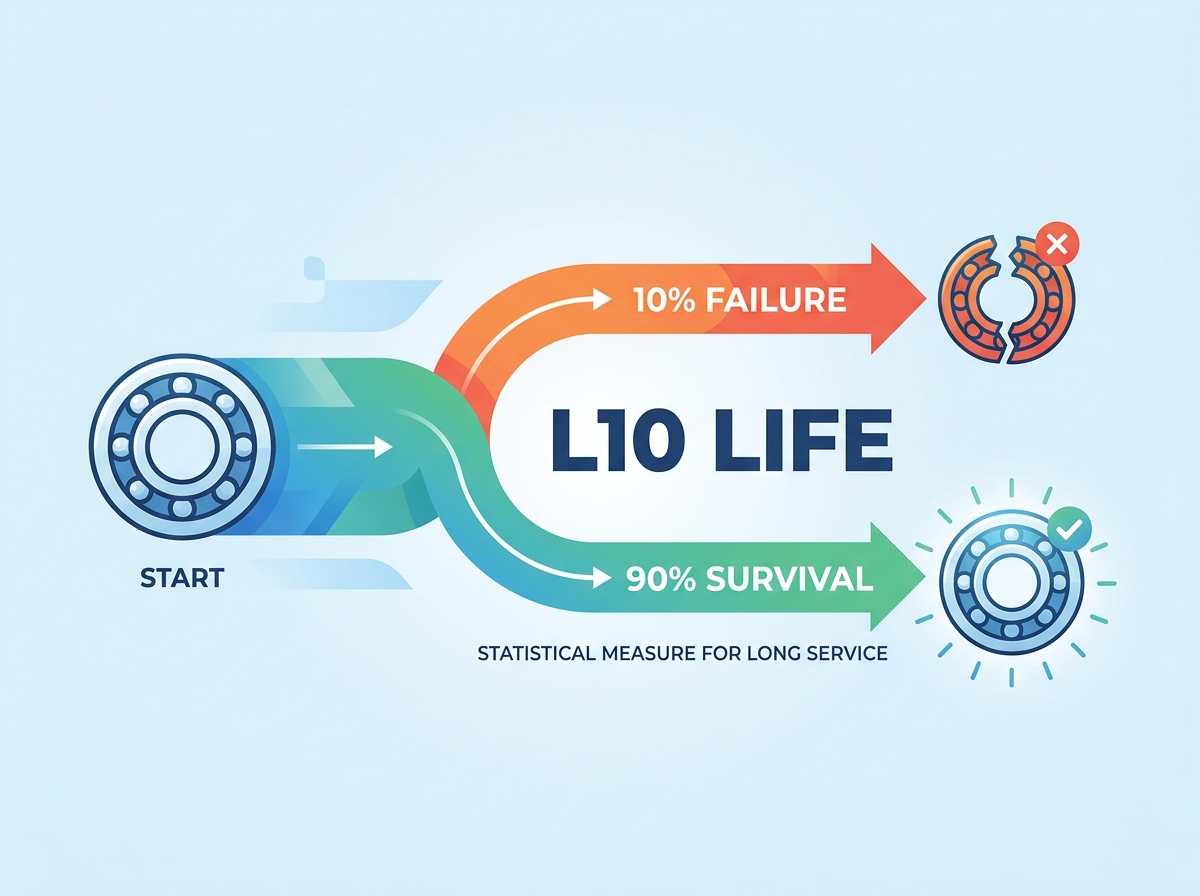
- The 90% Reliability Benchmark: L10 life represents the theoretical operating hours or revolutions that 90% of a group of identical bearings will achieve before the first signs of metal fatigue occur.
- Theoretical vs. Actual Service Life: Calculated L10 life is a baseline; actual service life is heavily dictated by real-world operating conditions, including lubrication quality, contamination, and installation precision.
- The L10a Advantage: Modified L10a calculations account for advanced manufacturing variables, such as ultra-clean steel, which are critical when specifying true long service life bearings.
- The 5-Stage Lifecycle: Achieving the calculated L10 expectancy requires managing all five stages of a bearing's lifecycle: selection, storage, installation, lubrication, and monitoring.
What is L10 Bearing Life? (The Baseline for Reliability)
The L10 metric serves as the foundational statistical probability of fatigue life in the mechanical engineering sector. Established by the International Organization for Standardization (ISO) and the American Bearing Manufacturers Association (ABMA), L10 life dictates the expected durability of rolling-element bearings. The testing methodology is highly controlled. Manufacturers operate a large sample size of identical bearings under strictly identical load and speed conditions. The test concludes for an individual unit when it exhibits the first microscopic signs of metal fatigue, typically presenting as spalling or flaking on the raceways or rolling elements. The L10 rating is established at the exact point where 10% of the tested bearings have failed, meaning 90% of the batch continues to operate flawlessly.
A critical engineering distinction exists between theoretical fatigue life and practical service life. Theoretical fatigue life, represented by L10, assumes perfect operating conditions: optimal lubrication, zero contamination, perfect alignment, and ideal ambient temperatures. Practical service life is the actual duration the bearing survives in a real-world industrial environment. A component can boast an exceptionally high L10 rating on paper but still suffer a drastically shortened service life if environmental factors are ignored. Selecting long service life bearings requires treating the L10 calculation as a starting point, not an absolute guarantee against poor maintenance practices.
| Metric | Definition | Primary Influencing Factors | Application in Field |
| L10 Fatigue Life | Theoretical life 90% of bearings reach before spalling. | Dynamic load (C), Equivalent load (P), Speed (RPM). | Used for initial sizing and specification during machine design. |
| Actual Service Life | Real-world operating hours before replacement is required. | Lubrication, contamination, alignment, vibration, temperature. | Used for maintenance scheduling and reliability tracking. |
| L10a Modified Life | Adjusted theoretical life accounting for material and lube. | Steel purity (a2), operating conditions (a3), reliability (a1). | Used to justify specifying premium bearings for harsh environments. |
Engineers must bridge the gap between the laboratory and the field. When a bearing fails at 2,000 hours despite an L10 rating of 50,000 hours, the root cause rarely involves defective steel. Instead, the failure stems from variables excluded from the basic L10 formula. Water ingress, particulate contamination, and improper mounting fits introduce stresses that bypass normal fatigue progression. To achieve the theoretical baseline, maintenance teams must replicate the laboratory's ideal conditions as closely as possible on the plant floor.
Core Variables in Calculating L10 Life
The basic dynamic load rating, denoted as C, is a fundamental variable in determining bearing longevity. It represents the constant radial load that a bearing can theoretically endure for exactly one million revolutions before fatigue occurs. However, bearings rarely experience simple, unidirectional loads in the field. To calculate accurate lifespans, engineers must determine the equivalent dynamic load, denoted as P. This calculation synthesizes combined radial and axial forces into a single theoretical load value, allowing for precise L10 estimations regardless of the complex force vectors applied by the machinery.
Operating speeds and duty cycles heavily influence the final calculation. There is a direct inverse relationship between operating speed, measured in revolutions per minute (RPM), and bearing lifespan. As RPM increases, the bearing accumulates fatigue cycles at an accelerated rate, rapidly depleting its L10 life. Variable duty cycles further complicate standard calculations. When a machine operates at fluctuating speeds and loads throughout its shift, engineers cannot rely on static numbers. They must perform weighted average load assessments, factoring in the percentage of time spent at each load and speed threshold to determine a realistic fatigue limit.
Sizing methodology diverges significantly depending on whether the application involves rotary or linear motion. Rotary bearing calculations are traditionally measured in hours of operation or millions of revolutions. Linear bearing L10 life calculations are measured in total distance traveled, typically expressed in kilometers or meters. Stroke length, velocity profiles, and dynamic load factors uniquely impact linear bearing sizing. Short, rapid strokes concentrate wear on specific sections of the linear rail, requiring distinct calculation adjustments to ensure the specification of true long service life bearings capable of handling repetitive, localized stress.
Consider a conveyor drive pulley operating under heavy belt tension. The radial load remains relatively constant, but the introduction of a helical gear reducer on the same shaft introduces an axial thrust load. The equivalent dynamic load (P) formula accounts for both vectors using specific X and Y factors provided by the manufacturer. If the engineer only uses the radial load for the L10 calculation, the resulting lifespan estimate will be dangerously optimistic, leading to unexpected failure and production halts.
Transitioning from L10 to L10a: Specifying Long Service Life Bearings
Material purity plays a dominant role in extending mechanical durability. Standard bearing steel contains microscopic non-metallic inclusions. Under heavy dynamic loads, these tiny impurities act as severe stress concentrators. They initiate subsurface micro-cracks that eventually propagate to the surface, causing the spalling that ends a bearing's useful life. Bearings manufactured with degassed, ultra-clean steel achieve significantly higher fatigue resistance. The vacuum degassing process removes oxygen and other impurities during smelting, resulting in a homogenous steel matrix that drastically delays the onset of metal fatigue.
The L10a modified life equation, outlined in the ISO 281 standard, allows engineers to account for these advanced materials and specific operating conditions. The equation introduces three critical life modification factors. Specifying components with favorable L10a ratings is the most direct engineering route to securing long service life bearings that will survive demanding industrial environments.
- a1 Factor (Reliability): Adjusts the calculation for reliability requirements greater than 90%. For critical aerospace or medical applications requiring 99% reliability (L1 life), this factor significantly reduces the expected lifespan number to ensure a higher safety margin.
- a2 Factor (Material): Accounts for the metallurgical quality of the bearing components. Bearings forged from vacuum-degassed, ultra-clean steel receive a higher a2 multiplier, directly increasing the calculated L10a life.
- a3 Factor (Operating Conditions): Adjusts for the actual operating environment, primarily focusing on lubrication quality (viscosity ratio) and the presence of contamination. A poor lubrication film or high particulate count will drive this factor below 1.0, slashing the expected lifespan.
When evaluating proposals from different manufacturers, the L10a calculation provides a level playing field. A standard bearing might show an L10 life of 20,000 hours. A premium bearing with identical dimensions but manufactured from ultra-clean steel might show an L10a life of 45,000 hours under the exact same load. This mathematical proof justifies the specification of higher-quality components for applications where maintenance access is difficult or downtime is unacceptable.
Evaluation Framework: Selecting Bearings for Maximum Uptime
Mapping application demands against bearing specifications requires a structured framework. Engineers must analyze shock loads, determine if the operation is continuous or intermittent, and evaluate temperature extremes. An industrial electric motor provides a perfect case study for this rigorous selection process. Motor-specific specifications, such as NEMA or IEC standards, dictate precise dimensional and performance requirements. A motor driving a belt experiences heavy radial loads, while a direct-drive application may introduce significant axial loads. Rigorous L10 calculations prevent catastrophic winding damage by ensuring the selected bearing can handle the specific force vectors without premature deflection or failure.
Analyzing the cost-benefit ratio of standard L10 bearings versus premium L10a bearings requires focusing on value-influencing factors. While premium bearings require a higher initial investment, they deliver a definitive return on investment through extended uptime. Specific scenarios demand high-purity, long service life bearings. Remote installations, such as offshore wind turbines or isolated mining conveyors, incur massive labor and logistical costs for component replacement. Machinery with high downtime costs also necessitates premium bearings, as the expense of lost production far outweighs the premium paid for ultra-clean steel and optimized internal geometries.
Supplier verification is mandatory to ensure the integrity of the L10a calculations. Decision-makers must establish strict criteria for vetting manufacturer claims. Relying on glossy marketing literature often leads to underperforming equipment. Engineering teams should request certified dynamic load ratings, detailed material certifications proving the use of vacuum-degassed steel, and empirical testing data. Verifying these documents ensures the bearings delivered match the theoretical calculations used during the design phase.
| Application Type | Primary Load Vector | Key Selection Criteria | Recommended Bearing Type |
| Electric Motor (Belt Drive) | Heavy Radial | High dynamic load rating, vibration resistance. | Cylindrical Roller Bearing or Heavy-Duty Deep Groove Ball Bearing. |
| Machine Tool Spindle | Combined Radial & Axial | Extreme precision, high-speed capability, rigidity. | Angular Contact Ball Bearings (Matched Sets). |
| Heavy Conveyor Pulley | High Radial, Shock Loads | Misalignment tolerance, high load capacity. | Spherical Roller Bearings. |
Implementation Realities: Overcoming the 5 Stages of Bearing Life
The holistic lifecycle of a bearing consists of five distinct stages. A failure in any single stage degrades the calculated L10 potential. Even the highest-rated long service life bearings will fail to reach their design life if mishandled during storage or installed with improper tools. Managing the entire lifecycle is the only way to translate theoretical fatigue life into actual field longevity.
- Design and Selection: Accurately calculating equivalent dynamic loads and specifying the correct L10a rating for the application.
- Storage and Handling: Keeping bearings in original packaging, storing them flat in a climate-controlled environment to prevent micro-corrosion and false brinelling from ambient vibration.
- Installation and Alignment: Using induction heaters or hydraulic presses to mount bearings, ensuring proper interference fits without transferring force through the rolling elements.
- Lubrication and Maintenance: Applying the correct volume and viscosity of grease or oil, and maintaining strict cleanliness to prevent particulate ingress.
- Health Monitoring and Decommissioning: Utilizing vibration analysis and thermography to track bearing health, allowing for scheduled replacement before catastrophic failure damages the shaft or housing.
Lubrication failures and contamination are the primary killers of rolling-element bearings. Inadequate film thickness allows metal-to-metal contact between the rolling elements and the raceway, generating immense heat and rapid wear. Improper lubricant selection, such as using grease with the wrong base oil viscosity for the operating temperature, accelerates this degradation. Particulate contamination bypasses fatigue life entirely. When dirt or metal shavings enter the bearing housing, they act as an abrasive compound, scoring the raceways and causing premature failure long before the L10 limit is reached.
Misalignment and improper installation tolerances introduce artificial loads that destroy bearings. Shaft misalignment forces the rolling elements to carry unequal loads, drastically exceeding the equivalent dynamic load (P) used in the initial L10 calculation. Improper housing fits can distort the outer ring, eliminating internal clearances and causing the bearing to bind. Aggressive mounting techniques, such as striking the bearing directly with a hammer, cause true brinelling—permanent indentations in the raceway that immediately compromise the bearing's structural integrity.
Maintenance and engineering teams must deploy strict mitigation strategies. Implementing clean-room handling procedures prevents initial contamination. Utilizing laser alignment tools ensures precision alignment protocols are met, eliminating parasitic loads. Finally, deploying condition monitoring technologies, including vibration analysis and thermography, allows teams to detect microscopic defects before they escalate into catastrophic failures. These proactive measures ensure the bearing reaches its fully calculated L10 life.
Conclusion
- Audit current bearing failure rates across all critical machinery to identify applications consistently falling short of their calculated L10 life.
- Recalculate equivalent dynamic loads (P) for problem applications, factoring in real-world shock loads and variable duty cycles that may have been missed during initial sizing.
- Update purchasing specifications to require ISO 281 modified life (L10a) calculations, demanding proof of ultra-clean steel and optimized internal geometries from suppliers.
- Implement mandatory laser alignment and precision mounting protocols for all maintenance staff to eliminate artificial loads and installation damage.
FAQ
Q: What is the difference between L10 and L50 bearing life?
A: L10 represents the life 90% of bearings will achieve, while L50 (median life) is the life 50% of bearings will achieve. L50 is typically 5 times longer than L10, but L10 is the standard for industrial reliability.
Q: How does lubrication affect the L10 life calculation?
A: Standard L10 assumes optimal lubrication. In modified life calculations (L10a/ISO 281), a viscosity ratio (kappa) is used to adjust the life expectancy based on actual lubricant film thickness.
Q: Can L10 life be converted to operating years?
A: Yes, by dividing the calculated L10 life in hours by the expected operating hours per year, though this remains a theoretical estimate dependent on consistent operating conditions.
Q: What does an L10a rating mean for bearing steel?
A: An L10a rating incorporates a life adjustment factor for material quality. Bearings made from ultra-clean, vacuum-degassed steel receive a higher L10a rating, indicating a longer expected service life than standard steel.
Q: Why did my bearing fail before reaching its calculated L10 life?
A: Premature failure is rarely due to material fatigue. It is most commonly caused by contamination, improper lubrication, misalignment, or installation damage that introduces loads outside the L10 calculation parameters.
Q: Is L10 life applicable to linear bearings as well as rotary?
A: Yes, L10 life applies to linear motion components. It is calculated using the dynamic load rating and the applied load, typically expressed in kilometers or meters of travel rather than revolutions.

 English


