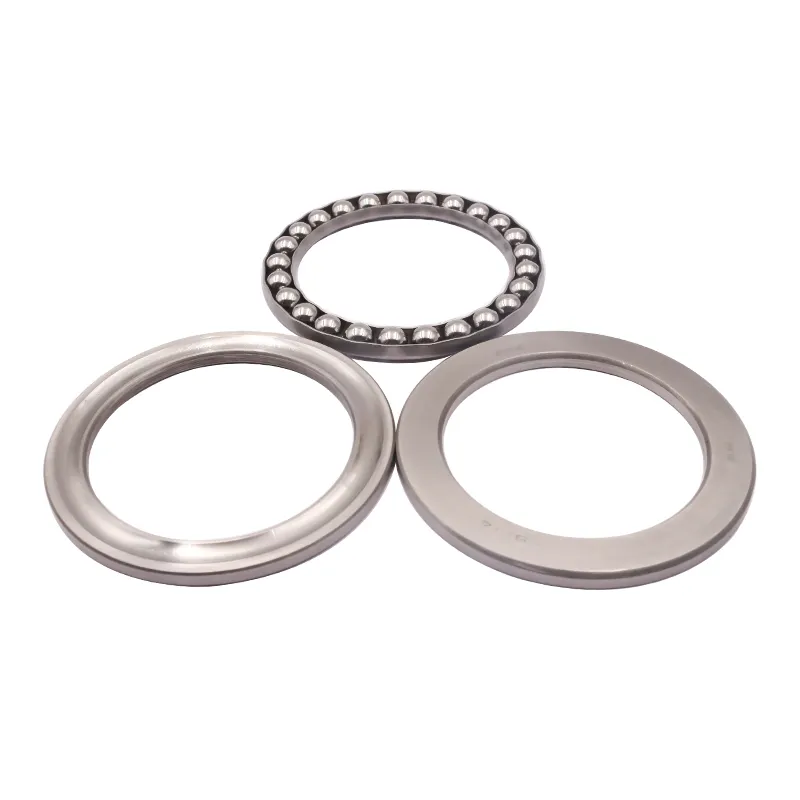
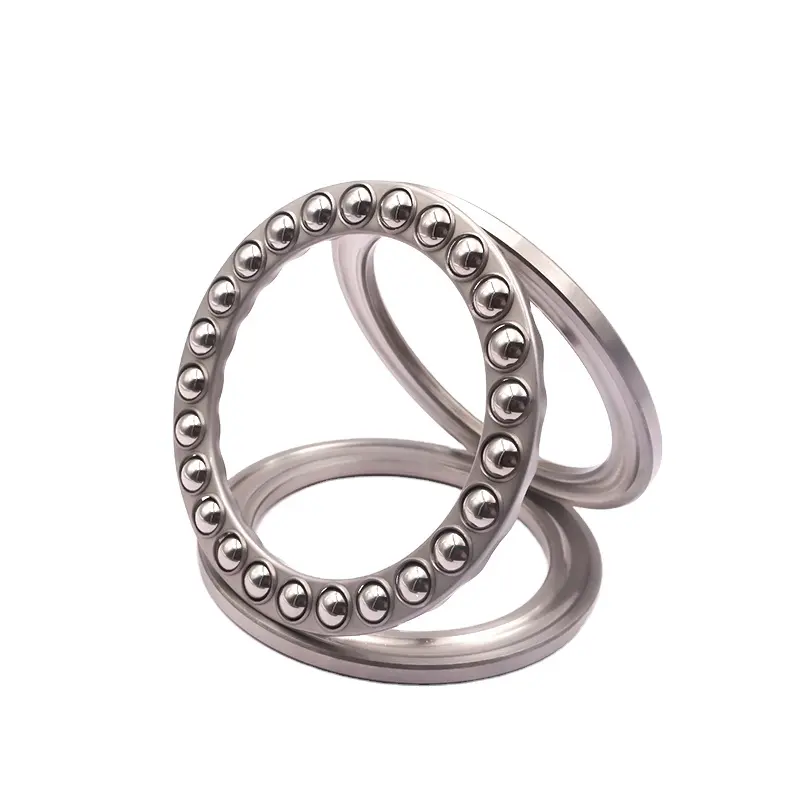
Our 51101 and 51103 thrust ball bearings are engineered exclusively for axial load applications, featuring a separable and interchangeable design that simplifies mounting and maintenance. With a 12mm bore, 26mm outer diameter and 9mm height, these units deliver 10.4kN dynamic load rating and 16.6kN static load rating, with reference speeds of 9,000 RPM and limiting speeds of 13,000 RPM. Suitable for industrial fans, pumps and metallurgy equipment, they are produced to ISO standards with OEM customization and 8-15 day delivery.
51101
STEEL
high quality
Barreled, bagged, boxed, palletized or as customers' requirement
The SL46 thrust ball bearing series covers single-direction thrust ball bearings in the 51100 size family, including models 51101. This bearing is designed to carry axial (thrust) loads in one direction and are not intended for radial load support. The separable design allows the shaft washer, housing washer, and ball and cage assembly to be installed individually, simplifying mounting procedures in applications where access is limited or where assembly sequence requires separate component installation.
Thrust ball bearings consist of two washer-shaped rings with raceway grooves, a set of balls, and a cage that maintains ball spacing. The bearing supports loads that act parallel to the shaft axis, making it suitable for applications where axial positioning and thrust load management are primary requirements. Common applications include industrial fans, pumps, metallurgy equipment, machine tools, and valve assemblies.
Dimensional and Performance Specifications
Parameter
Value
Model
51101
Bore diameter
12 mm
Outside diameter
26 mm
Height
9 mm
Basic dynamic load rating
10.4 kN
Basic static load rating
16.6 kN
Reference speed
9000 r/min
Limiting speed
13000 r/min
Product net weight
0.022 kg
Material
Steel
Package
Barreled, bagged, boxed, palletized or as customers' requirement
Service
OEM service provided
Delivery Time
8-15 days, depends on quantity needed
Note: The dimensional and performance values listed above correspond to the 51101 model. Buyers requiring specifications for 51102 and 51103 should confirm the applicable parameters at the time of inquiry.
Design Features
Separable Structure
The thrust ball bearing features a fully separable design. The shaft washer (the ring mounted on the shaft), the housing washer (the ring mounted in the housing), and the ball and cage assembly can all be handled as separate components during installation. This design is advantageous in applications where the shaft and housing are assembled in separate stages, or where maintenance requires access to the bearing without full disassembly of the assembly.
Axial Load Carrying Capacity
These bearings are engineered specifically for axial load support. The basic static load rating of 16.6 kN (for the 51101 model listed) indicates the load the bearing can support without permanent deformation of the raceway surfaces or rolling elements. The basic dynamic load rating of 10.4 kN represents the load under which the bearing achieves a rated fatigue life of one million revolutions. Actual service life depends on load magnitude, operating speed, lubrication conditions, and environmental factors.
Material and Heat Treatment
The bearing rings and rolling elements are manufactured from bearing steel. The material undergoes heat treatment to achieve the hardness required for rolling contact fatigue resistance and dimensional stability under load. The cage, which separates and guides the rolling elements, is typically constructed from stamped steel or other cage materials depending on the specific model and application requirements. Buyers with specific material certification requirements should request the applicable documentation at the time of order.
Industrial Applications
Thrust ball bearings serve a range of industrial applications where axial loads must be managed. In pump assemblies, they handle thrust forces generated by impeller operation. In industrial fans, they support axial loads from fan wheel operation. In metallurgy equipment, they are used in various rolling and processing machine components. In machine tool applications, they provide axial positioning for spindle assemblies. In valve actuators and lifting equipment, they support thrust loads during operation. The specific model selection depends on the required load capacity, shaft diameter, and housing dimensions of the application.
Mounting and Maintenance Considerations
Proper mounting is important for thrust ball bearing performance. The shaft washer and housing washer must be aligned such that the load is distributed evenly across the raceway. Misalignment can lead to uneven load distribution and reduced service life. The bearing should be lubricated with grease or oil appropriate for the operating speed and temperature conditions of the application.
While the bearing has a specified limiting speed, thrust ball bearings generally operate at lower rotational speeds than deep groove ball bearings of comparable size due to the centrifugal forces acting on the rolling elements in the raceway grooves. Applications requiring high-speed rotation should evaluate whether a thrust ball bearing is the appropriate bearing type or whether an alternative design should be considered.
Packaging and Ordering
The bearings are available in multiple packaging formats including barreled, bagged, boxed, and palletized configurations, or according to customer-specified requirements. OEM service is available for buyers requiring custom packaging, labeling, or specification adjustments. Standard delivery time ranges from 8 to 15 days depending on order quantity.
FAQ
Can thrust ball bearings carry radial loads?
No. Thrust ball bearings are designed to carry axial loads only. They are not intended to support radial loads. Applications that require both radial and axial load support should consider other bearing types such as angular contact ball bearings or tapered roller bearings.
What does the separable design mean for installation?
The separable design means the shaft washer, housing washer, and ball-cage assembly can be installed independently. This simplifies mounting in applications where the shaft and housing are assembled at different stages, or where the bearing needs to be serviced without fully disassembling the equipment.
What is the difference between reference speed and limiting speed?
Reference speed is the speed at which the bearing can operate under standard thermal equilibrium conditions with conventional lubrication. Limiting speed is the maximum speed at which the bearing can operate, limited by mechanical factors such as cage strength and rolling element centrifugal forces. Both values should be considered when selecting a bearing for a specific speed requirement.

 English