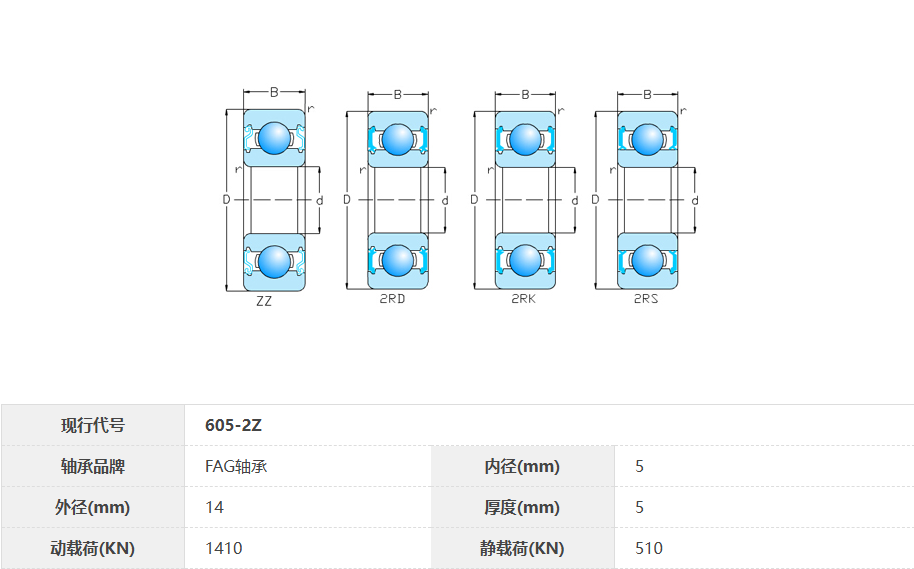
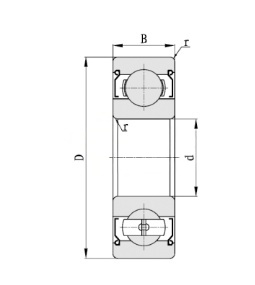
The 605ZZ is a miniature deep groove ball bearing with an inner diameter of 5 mm, an outer diameter of 14 mm, and a thickness of 5 mm. It features a dual-metal dust cover (ZZ) structure and is one of the most widely used miniature bearing models. Its compact design and smooth operation make it widely used in various small motors, power tools, office equipment, models, and precision instruments.
The Deep Groove Ball Bearing with Dual Dust Covers represents the pinnacle of friction-reduction technology, meticulously crafted to transform raw mechanical power into seamless, whisper-quiet motion. When you hold this miniature component, the polished finish of the high-carbon chromium steel feels distinctly robust, reflecting a manufacturing process obsessed with microscopic tolerances. As it spins, the absence of grinding or clicking sounds is immediately noticeable, replaced instead by a smooth, aerodynamic hum that signifies perfectly spherical rolling elements gliding through immaculately honed raceways. This is not just a rotational pivot; it is a vital safeguard for your complex machinery, designed to drastically reduce thermal buildup and prevent premature wear in high-stakes environments.
By integrating this bearing into your product lines, you are actively eliminating the costly downtime associated with component failure. The dual metal shields act as an impenetrable fortress against abrasive particulates and moisture, locking in the specialized grease while keeping environmental contaminants at bay. Whether deployed in precision medical instruments, high-velocity cooling fans, or advanced robotics, the structural integrity of this bearing ensures that your equipment operates with unwavering reliability. The sleek, thin-walled architecture maximizes space utilization without compromising load-bearing capacity, granting engineers the ultimate freedom to design more compact, efficient, and powerful devices that outpace market expectations.
Lubrication and sealing are closely related and jointly determine the rotational speed, service life, and operating environment of bearings. The core function of lubrication is to reduce friction, minimize wear, dissipate heat, and prevent corrosion. The role of sealing is to prevent external contaminants (dust, moisture) from entering while also preventing leakage of internal lubricating grease.
Grease vs. Lubricating Oil
Lubricating System
Characteristic
Applicable Scene
Grease
Semisolid, with excellent sealing performance, low leakage tendency, and long maintenance-free cycle; the factory-standard choice for the vast majority of 605 bearings
General motors, home appliances, office equipment
Lubricating Oil
Excellent fluidity, rapid heat dissipation, reduced friction torque, and higher maximum rotational speed
Ultra-high-speed applications (e.g., electric spindles), high-temperature environments
Grease Type
Lubricant Type
Temperature Range
Characteristic
Typical Applications
Lithium-based fat
-20°C ~ +120°C
Universal design with high cost-effectiveness
General motors, general equipment
Polyurea resin
-30°C ~ +150°C
Heat-resistant, oxidation-resistant, long service life, and low noise
Precision motors, household appliances
Fluorinated lipid
-50°C ~ +250°C
Highly resistant to high temperatures and chemical corrosion, but with a high cost
Oven equipment, vacuum environment
Low-torque grease
-40°C ~ +120°C
The friction torque is minimal, making it suitable for low-temperature startup
Precision instruments, drones
Lubrication Reference Data
Project
Open (Oil Lubricated)
ZZ / 2RS (Grease Lubricated)
Limiting speed (reference)
Approximately 50,000 to 60,000 rpm
Approximately 39,000 to 50,000 rpm
Re-lubrication cycle
Add regularly according to operating conditions
Generally maintenance-free, unsuitable for re-lubricated structures
Industrial environments with severe dust pollution
2RS
Extremely high rotational speed requirement
Open type (with oil lubrication)
Key Features & Highlights
Engineered for maximum operational efficiency, this miniature bearing addresses the most critical challenges faced in modern mechanical assemblies. It bridges the gap between spatial constraints and heavy-duty performance, ensuring your machinery runs longer and faster.
Exceptional Load Versatility: The optimized deep-groove geometry allows the raceways to seamlessly manage intense radial forces while simultaneously absorbing axial thrusts from both directions, preventing shaft misalignment.
Frictionless High-Speed Capabilities: Crafted with an ultra-low friction coefficient, the rotational elements glide effortlessly, generating minimal heat even when pushed to extreme velocities, thereby protecting adjacent heat-sensitive components.
Self-Aligning Forgiveness: Designed to accommodate minor installation deviations (ranging from 2 to 10 arcminutes), this feature dramatically reduces the stress placed on housing bores during rapid assembly processes.
Long-Term Durability: The robust structural integrity requires virtually no manual intervention post-installation, drastically cutting down on routine maintenance schedules and associated labor costs.
Adaptive Sealing Configurations: By utilizing specific suffix designations, the base architecture can be instantly tailored to repel fine dust, resist water ingress, or operate openly in submerged oil baths.
Core Material & Heat Treatment Craftsmanship
The foundation of any superior rotational component lies in its metallurgical composition. By utilizing premium-grade materials, these bearings are forged to withstand relentless mechanical stress without succumbing to deformation or surface fatigue.
High-Carbon Chromium Dominance: The standard configuration employs GCr15 (52100) bearing steel, renowned for its exceptional purity and structural density, providing a flawless canvas for the rolling elements.
Advanced Thermal Processing: Through rigorous heat treatment cycles, the inner and outer rings achieve a formidable surface hardness of HRC 60-64, locking in a microscopic grain structure that exponentially increases contact fatigue life.
Corrosion-Resistant Alternatives: For applications exposed to caustic chemicals or high humidity, the 440C stainless steel variant alters the material matrix to actively repel oxidation while maintaining structural rigidity.
Ceramic Ball Integration: When extreme temperatures or electrical insulation are required, optional ceramic rolling elements can be deployed to prevent arcing and reduce overall rotational mass.
Precision Ratings & Acoustic Vibration Control
In environments where acoustic discretion is paramount, mechanical grinding or rattling is unacceptable. This bearing is calibrated to EMQ (Electric Motor Quality) standards, ensuring a whisper-quiet operational footprint that enhances the end-user's perception of your equipment.
EMQ-Grade Manufacturing: Machined to exacting tolerances, the raceways exhibit near-perfect concentricity, virtually eliminating the micro-bouncing that causes low-frequency hums in standard bearings.
Z1V1 to Z4V4 Acoustic Compliance: Rigorously tested to meet stringent noise and vibration thresholds, making them the invisible, silent driving force behind high-end precision instruments, printers, and household appliances.
Coronary Retainer Technology: The integration of engineering plastics (like PA66) or copper alloy cages, formed via precision injection molding, creates a dampening effect that absorbs kinetic resonance during rapid acceleration.
Optimized Grease Distribution: Specialized dampening lubricants are evenly channeled throughout the ball path, creating a fluid cushion that suppresses metal-on-metal acoustic emissions.
Advanced Sealing Architecture & Lubrication Systems
A bearing's lifespan is inextricably linked to its internal purity. Our comprehensive sealing and lubrication strategies are designed to create an impenetrable barrier against environmental hazards while ensuring optimal fluid dynamics inside the raceway.
Dual Metal Dust Covers (ZZ): The standard ZZ configuration utilizes precision-stamped steel shields that provide a robust physical barrier against airborne particulates, perfectly balancing contamination protection with ultra-low friction rotation.
Rubber Seal Variants (2RS): For environments plagued by moisture or heavy debris, the 2RS synthetic rubber seals create a tight lip contact with the inner ring, effectively locking out water and abrasive slurry.
Pre-Filled Maintenance-Free Operation: Injected at the factory with precise volumes of high-performance grease (such as Lithium-based or Polyurea resin), eliminating the need for manual re-lubrication intervals.
Custom Fluid Dynamics: For specialized thermal environments, the internal cavity can be provisioned with Fluorinated lipids for extreme heat resistance, or low-torque oils to facilitate instant startup in sub-zero climates.
Extreme Velocity & Composite Load Capacity
Modern engineering demands components that can push the boundaries of speed without sacrificing load-bearing stability. The deep groove, thin wall architecture of this model is specifically calibrated to handle intense kinetic energy.
Unprecedented Rotational Limits: Engineered to minimize centrifugal drag, the shielded models effortlessly sustain speeds up to 40,000 rpm, while the open, oil-lubricated variants can achieve a staggering 50,000 to 60,000 rpm.
Deep Groove Geometry: The curvature radius of the tracks is meticulously machined to be slightly larger than the steel balls, transforming point contact into a broader arc surface that distributes heavy radial loads evenly.
Bidirectional Axial Support: Unlike standard angular contact models, the depth of these raceways allows the bearing to absorb sudden axial thrusts from either direction, stabilizing motor rotors during rapid directional shifts.
Thermal Expansion Accommodation: By utilizing C3 or MC4 internal clearance configurations, the bearing safely absorbs the microscopic expansion of metal at peak velocities, preventing catastrophic seizure.
Space is a premium commodity in contemporary device design. This miniature bearing delivers heavy-duty functionality within an incredibly restricted footprint, granting engineers the geometric freedom to innovate.
Ultra-Thin Radial Cross-Section: With a 5mm inner diameter and a 14mm outer diameter, the single-side wall thickness is reduced to a mere 4.5mm, making it the definitive choice for micro-motors and compact gearboxes.
Micro-Chamfer Engineering: Featuring a chamfer radius of just 0.2mm, the bearing can be seated flush against incredibly tight shaft shoulders, maximizing every millimeter of the housing cavity.
Inherent Auto-Centering: The internal geometry naturally compensates for minor shaft misalignments (ranging from 2 to 10 arcminutes) occurring during rapid assembly, preventing the buildup of destructive internal stresses.
Assembly Line Efficiency: The robust outer ring is designed to withstand the uniform pressure of automated press-fitting tools, streamlining high-volume production workflows without risking component deformation.
Rigorous Quality Control & International Certification
Trust in industrial procurement is built on verifiable consistency. Every single bearing that leaves the facility has survived a gauntlet of microscopic inspections and brutal performance stress tests to guarantee absolute reliability.
Source Material Verification: Every batch of raw steel, synthetic rubber, and lubricating grease undergoes strict metallurgical and chemical analysis before entering the production floor.
Statistical Process Control (SPC): Real-time laser micrometers monitor the grinding and ultra-precision machining phases, instantly correcting deviations to prevent batch defects before they occur.
100% Comprehensive Final Inspection: We do not rely on random sampling. Every unit is subjected to automated testing for dimensional accuracy, radial clearance, acoustic emissions, and rotational friction.
Global Compliance Standards: Backed by ISO 9001 quality management systems and RoHS environmental certifications, ensuring seamless integration into compliant global supply chains and export markets.
Flexible Supply Chain & OEM/ODM Customization
Your operational requirements are unique, and your component supplier should adapt to your specific engineering challenges. We provide an agile, highly responsive manufacturing infrastructure designed to scale with your production demands.
Bespoke Dimensional Adjustments: Beyond standard specifications, our engineering team can modify internal clearances (such as C3/C4) and chamfer profiles to match non-standard housing tolerances.
Proprietary Branding Solutions: Enhance your product's perceived value with custom laser-etched logos on the bearing shields and tailored packaging solutions designed for your specific assembly line feeding systems.
Direct-from-Source Economics: By eliminating intermediary markups, we deliver premium-grade components at a cost structure that significantly improves your overall manufacturing margins.
Rapid High-Volume Fulfillment: Leveraging expansive inventory reserves and agile production scheduling, we guarantee rapid turnaround times to keep your assembly lines moving without interruption.
Why Partner With Us for Your Component Sourcing?
Selecting the right manufacturing partner is just as critical as selecting the right component. We bring decades of metallurgical expertise and precision engineering directly to your production floor, ensuring that your supply chain remains robust, predictable, and highly competitive.
Uncompromising Engineering Standards: We treat every miniature bearing as a critical safety component, applying aerospace-level scrutiny to everyday industrial applications.
Seamless Integration Support: Our technical teams work directly with your engineers to select the exact lubrication, clearance, and sealing configurations required for your specific prototype.
Scalable Production Capacity: Whether you require a specialized small-batch run for a new product launch or millions of units for established global distribution, our facilities scale instantly to your needs.
Transparent Traceability: From the raw steel ingot to the final packaged product, every step of our manufacturing process is documented and fully traceable, providing absolute peace of mind for your quality assurance teams.
Commitment to Longevity: We don't just supply parts; we supply reliability. By reducing your equipment failure rates, we actively help protect and elevate your brand's reputation in the marketplace.
Frequently Asked Questions (FAQ)
To assist your engineering and procurement teams, we have compiled detailed answers to the most complex technical inquiries regarding our miniature bearing solutions.
What is the functional difference between the ZZ and 2RS sealing configurations?
The ZZ configuration utilizes dual metal shields that provide excellent protection against larger airborne dust particles while maintaining a completely frictionless rotation, making it ideal for high-speed indoor applications. The 2RS configuration employs synthetic rubber seals that make physical contact with the inner ring, creating a superior barrier against moisture and fine slurry, though this introduces a slight friction torque that marginally reduces the maximum limiting speed.
Can these bearings handle high-temperature operational environments?
Yes. While the standard GCr15 steel and lithium-based grease are rated for temperatures up to 120°C, we can customize the bearing for extreme heat. By upgrading the internal clearance to C3 or C4 to accommodate thermal expansion, and injecting specialized fluorinated lipids, the bearing can maintain stable operation in environments reaching up to 250°C without grease degradation or metal seizure.
Why would I choose a ceramic ball configuration over standard chromium steel?
Ceramic rolling elements are significantly lighter and harder than steel. This reduces centrifugal force at ultra-high speeds, minimizing heat generation and extending fatigue life. Furthermore, ceramic is electrically insulating, making it the perfect choice for electric vehicle motors or high-voltage applications where electrical arcing could pit and destroy standard steel raceways.
How does the internal clearance (C0 vs. C3) affect motor performance?
Internal clearance dictates the microscopic space between the balls and the raceways. Standard C0 clearance is perfect for general applications with stable temperatures. However, in high-speed electric motors, the shaft often heats up faster than the housing, causing the inner ring to expand. A C3 clearance provides slightly more internal room to absorb this expansion, preventing the bearing from locking up under heavy thermal loads.
Is it necessary to perform a run-in procedure after installation?
For standard grease-lubricated applications, a run-in is generally not required. However, for ultra-high-precision setups or when utilizing ceramic balls and specialized oils, a brief no-load run-in (idling the motor for approximately 5 minutes) is highly recommended. This allows the rolling elements to carve an optimal, microscopic contact trajectory into the raceway, preventing sliding damage and ensuring maximum longevity when full load is eventually applied.

 English