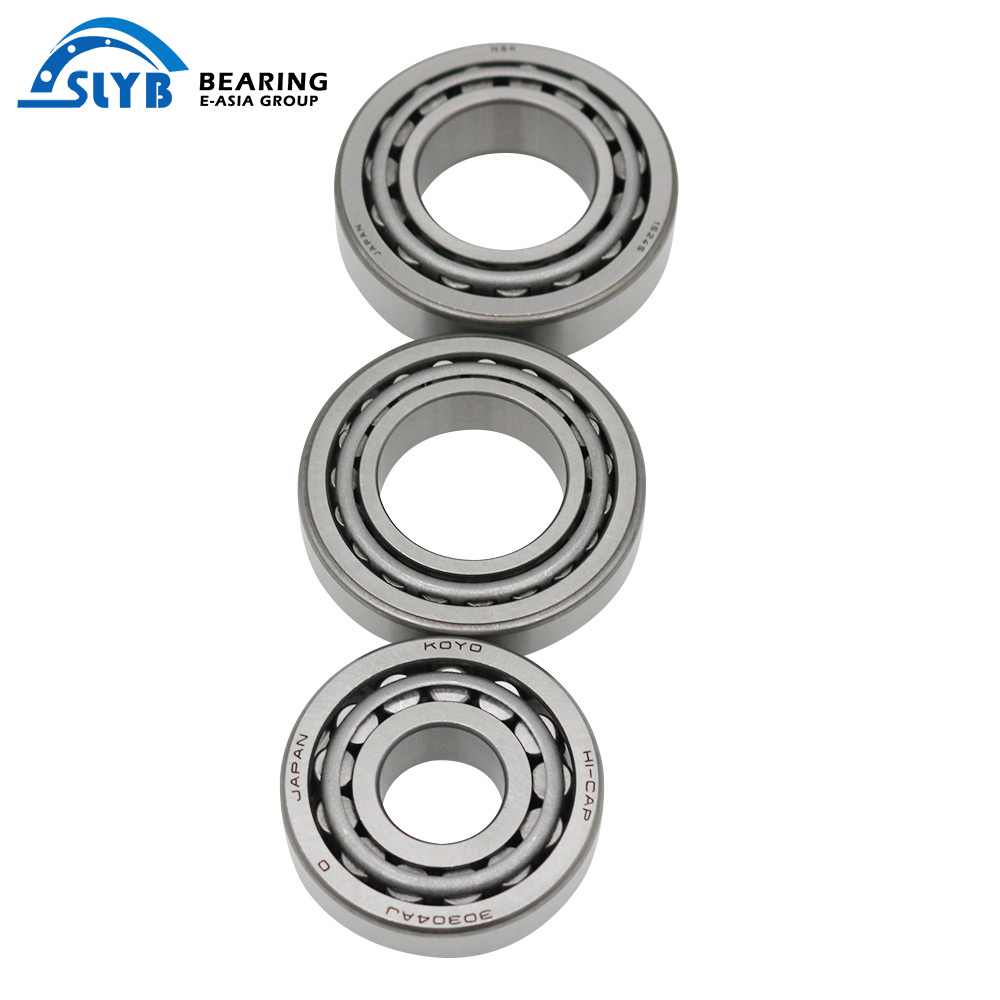
Our high-speed tapered roller bearings are precision-engineered from chrome steel, with stainless steel variants available for corrosion-prone environments. Rated for speeds up to 10,000 RPM, these units serve gearboxes, wheel hubs and transmissions across passenger vehicles and commercial trucks. Hybrid ceramic-steel designs reduce friction and extend service life. Produced to ISO and DIN standards with full factory inspection, we support commercial procurement buyers with OEM customization and technical installation guidance.
Tapered roller bearings are rolling element bearings designed to carry combined radial and axial loads. Manufactured from GCr15 chrome steel (SAE 52100 equivalent), these bearings feature tapered rollers arranged between conical inner and outer ring raceways. The design makes them suitable for automotive wheel hubs, transmissions, differentials, and other industrial applications requiring combined load capacity for commercial procurement.
Design Features of Chrome Steel Tapered Roller Bearings
Tapered Roller Geometry
The rolling elements are tapered (conical) in shape, matching the angled raceways of the inner and outer rings. This geometry distributes contact stress along the roller length and enables the bearing to support both radial and axial loads simultaneously. The contact angle, typically ranging from 10° to 30°, determines the ratio of radial to axial load capacity.
Separable Design
Tapered roller bearings have a separable design, meaning the inner ring with rollers (cone) and the outer ring (cup) can be installed separately. This feature simplifies mounting and allows for adjustment of bearing preload during assembly.
Cage and Precision Options
Steel cages are standard for most automotive and industrial applications, providing roller guidance and maintaining proper spacing. Precision grades range from P0 (standard) to P6, P5, and P4, with higher grades offering tighter dimensional tolerances for precision machinery applications.
Technical Specifications of Automotive Tapered Bearings
Parameter
Value (Typical 30205 Size)
Standard
Bore Diameter (d)
25 mm
ISO 355
Outer Diameter (D)
52 mm
ISO 355
Width (T)
16.25 mm
ISO 355
Inner Ring Width (B)
15 mm
ISO 355
Outer Ring Width (C)
13 mm
ISO 355
Basic Dynamic Load Rating (C)
37.2 kN
ISO 281
Basic Static Load Rating (C0)
37.5 kN
ISO 76
Limiting Speed (Grease Lubrication)
9,000 r/min
—
Material
GCr15 Chrome Steel
GB/T 18254
Cage Material
Steel
—
Precision Grade
P0 / P6 / P5
ISO 492
Load Capacity and Performance of Tapered Roller Bearings
Radial and Axial Load Handling
Tapered roller bearings carry both radial and unidirectional axial loads. The axial load capacity increases with the contact angle. For applications requiring bidirectional axial load support, two bearings are typically mounted in face-to-face or back-to-back pairs.
Speed Considerations
The limiting speed of tapered roller bearings depends on bearing size, cage design, lubrication method, and operating temperature. Smaller bearings generally have higher limiting speeds. Proper lubrication and preload adjustment are necessary to achieve rated speed performance in service.
Fatigue Life
Bearing fatigue life follows the ISO 281 standard, calculated based on dynamic load rating and applied loads. Actual service life varies with operating conditions including load magnitude, speed, lubrication quality, and contamination levels.
Industrial Applications of Chrome Steel Bearings
Automotive Systems
Tapered roller bearings are widely used in automotive wheel hubs, manual transmissions, differential gears, and steering knuckles. Their combined load capacity supports the forces encountered during vehicle operation, including cornering and acceleration loads.
Construction and Mining Machinery
In construction equipment, mining machinery, and agricultural equipment, these bearings handle heavy loads in harsh environments. The robust design and chrome steel material provide wear resistance under contaminated conditions.
Industrial Gearboxes and Conveyors
Industrial gearboxes, conveyor systems, and material handling equipment use tapered roller bearings where combined radial and axial loads are present. The separable design facilitates maintenance and replacement in industrial settings.
Mounting and Maintenance Guidelines for Tapered Bearings
Proper mounting requires correct preload adjustment, which affects bearing performance and service life. Bearings should be mounted on clean, properly dimensioned shafts and housings. Lubrication with appropriate grease or oil is essential, with relubrication intervals determined by operating conditions. Regular inspection for abnormal noise, vibration, or temperature changes supports proactive maintenance.
FAQ About Tapered Roller Bearings
What is the difference between tapered roller bearings and ball bearings?
Tapered roller bearings use conical rolling elements and can carry both radial and axial loads, making them suitable for heavier combined load applications. Ball bearings use spherical balls and generally offer higher speed capability but lower load capacity per unit size.
Can tapered roller bearings handle axial loads in both directions?
Single-row tapered roller bearings carry axial loads in only one direction. For bidirectional axial load support, two bearings must be mounted in pairs (face-to-face or back-to-back arrangement).
What does the precision grade mean?
Precision grades (P0, P6, P5, P4) indicate dimensional tolerance levels. P0 is standard precision for general applications, while P5 and P4 grades are used for machine tools and other precision equipment requiring tighter tolerances.
How should tapered roller bearings be lubricated?
Grease lubrication is common for most applications. Oil lubrication may be used for high-speed or high-temperature conditions. The lubricant should be selected based on operating speed, temperature, and load conditions.

 English